
Artist Wang Mansheng crafts his own brushes from found natural materials. In this short film, Mansheng reflects on the value of imperfection and the beauty of the handmade as he prepares for his exhibition “Wang Mansheng: Without Us." The video captures the artist at work and in conversation, revealing how years of experimentation have shaped his distinctive practice.

Na zijn afstuderen in 1985 aan de Chinese afdeling van de Fudan-universiteit in Shanghai, waar hij klassieke literatuur studeerde, werkte Wang meer dan tien jaar als redacteur, regisseur en producent bij China Central Television in Peking. Sinds zijn verhuis naar New York in 1996 heeft hij zich volledig toegelegd op schilderen en kalligrafie. De imaginaire landschappen die Wang creëert met behulp van experimentele technieken, gereedschappen en media in combinatie met traditionele penseelvoering, zijn vaak samengesteld in dialoog met Chinese klassieke thema’s.

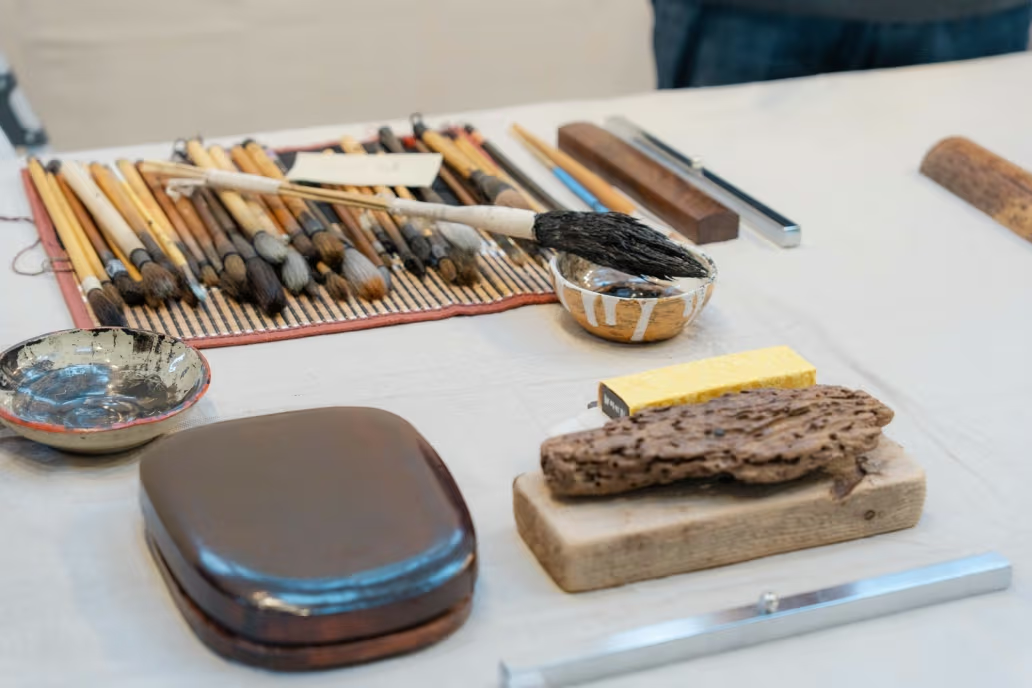
“When I paint a single piece, I usually use four or five brushes. For Without Us, the scale is much larger, so I needed bigger and more varied brushes. Over the course of the year I spent on this project, I used around 30 different brushes. They come in all shapes and sizes. I make one type myself from reeds that grow in the Hudson River near my home. There are hundreds of acres of reeds there—it’s very convenient. I’ve been using this kind of brush for about 15 years.” (The Huntington. Miranda Claxon)
https://www.huntington.org/news/interview-artist-wang-mansheng
| The Huntington.

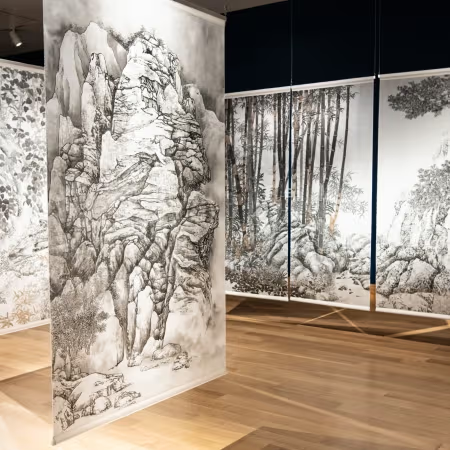
Wangs werken zijn voornamelijk gebaseerd op zijn verbeelding, gevoed door zijn diepe liefde voor de natuur, met name bergen, een favoriete bestemming voor de schetsen en foto's die als bron dienen. Zijn gevoelens en stemming leiden hem naar zijn onderwerp; hij begint vaak met een abstract monotype-beeld en zet dan een stap terug om te zien waar de ‘aders’ van de formaties en de stroming van het water zich openbaren. Door de gelaagdheid van gedurfde penseelstreken, inktwasbeurten en onconventionele technieken die drukwerk en schilderkunst combineren, voelen zijn werken meer driedimensionaal aan dan klassieke Chinese schilderijen. (fuquiumeng)

“I love California for its variety of landscapes and its incredible diversity of plants. When I first walked into The Huntington, I thought, “This is heaven on Earth.” The exhibition is in the heart of the Chinese Garden, so by the time visitors reach the gallery, they’ve already experienced half a mile of trees, flowers, and bamboo—it’s the perfect setting.
I hope people will take a moment to think about the Earth: what it looks like with us, shaped by human hands, and what it might look like without us. We should all keep this in mind so we can preserve and enjoy our planet for as long as possible. That’s my hope.” “(The Huntington)

Op basis van zijn ervaringen in de bergen legt Wang Mansheng het transformerende effect vast van het veranderende zonlicht op het landschap. Zijn afbeelding van bergen weerspiegelt deze dynamische verschuiving, met een subtiele waas die ontstaat wanneer het licht weerkaatst op de rotsen. Dit schilderij suggereert een zonsondergang, waarbij de nadruk ligt op de manier waarop het vervagende licht het uiterlijk van de berg verandert en het tafereel een diep gevoel van stilte en rust geeft.
In autumn, the reed flowers bloom. I comb out the seeds and trim the flowers. Depending on their size, I use one or tie several together to make a brush. Some are for fine lines; others cover larger areas, like the surface of a rock.
On a Cold New Year’s Eve
- Poetry of Yu Qian
《除夜太原寒甚》

I tell those who roam
To make light of cold.
Spring wind will soon come
Eastwards as foretold.

中文原文(
寄语天涯客,轻寒底用愁。
春风来不远,只在屋东头。
Te bekijken:
https://fuqiumeng.com/artists/33-wang-mansheng/

2016
Ink, Walnut Ink and Color on Paper
29 x 31 in.

