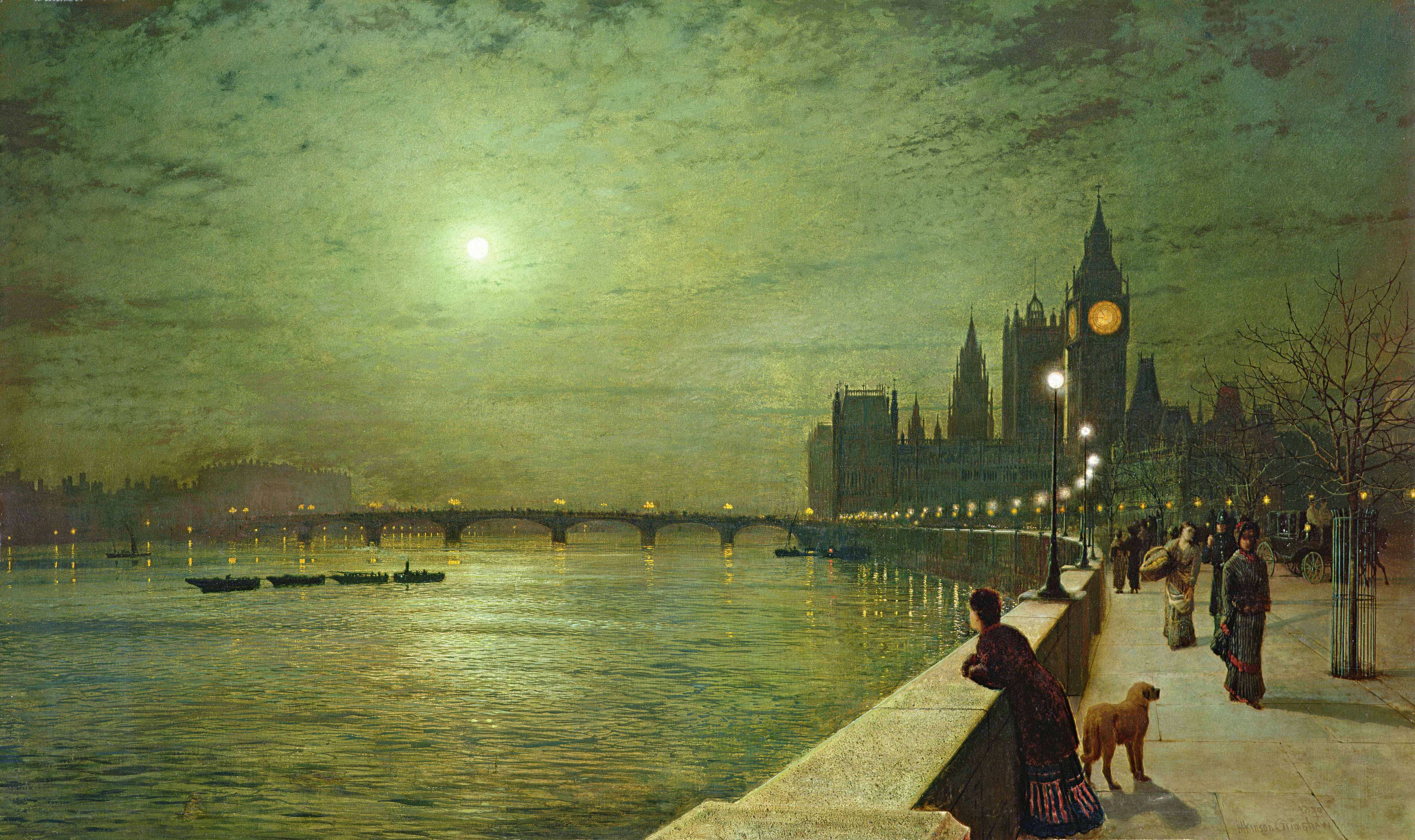
In zijn Essays ‘Characteristics’ schrijft Carlyle deze merkwaardige uitspraak: ‘Whoever looks upon the world, comparing the Past with the Present, may find that the practical condition of man in these days is one of the saddest; burdened with miseries which are in a considerable degree peculiar.’
Niet dadelijk manegeur en rozenschijn over het Victoriaanse landschap bij diegenen die nu op het punt staan zich uit het Europa van vandaag terug te trekken in hun bekende ‘splendid isolation’. De angsten die toen (en nu?) nieuwe tijden eigen waren: schrik voor revolutie, het groeiende atheïsme, zorgen en vermoeidheid, de hang naar puritanisme, verveling en twijfels, isolatie, eenzaamheid en heimwee, om er maar enkele te noemen en je kunt hiermee de beschrijving van Carlyle hierboven best begrijpen. Een transitie van een feodale naar een democratische tijd (althans voor de middenklasse) gaat dus niet in de bekende koude kleren zitten. Tijd dus voor een schilder die troost brengt in barre tijden: John Atkinson Grimshaw, als geen ander vertrouwd met het maanlicht, de schemering en herfstige intimiteit.
Late October
John Atkinson Grimshaw first began painting while working as a clerk for the Great Northern Railway. He encountered bitter opposition from his parents, but after his marriage in 1858 to a cousin of T.S. Cooper, he was able to devote himself full time to painting. Self-taught, Grimshaw started exhibiting in Leeds in the 1860's with minutely observed still life's. By 1870, he was successful enough to rent a 17th century mansion, following the death of three of his children at his Leeds home. He called it Castle by the Sea, perched on a cliff top, it has magnificent views of both the north and south bays. The name of his Scarborough house came from a poem by Longfellow. The move to the coast inspired much of the artist's most attractive work, throughout his career he was always attracted by ships, the sea and docks, in fact all things maritime.(klik op onderschrift)
By the 1870s he had become Leeds’ favourite homegrown artist, his new paintings eagerly awaited and enthusiastically reviewed. When the purchase of Roundhay Park was in question he exhibited three moonlight scenes of the Park which he said he had been commissioned to paint; they were lavishly praised in the press (and remain favourites today). He was acknowledged as the master of poetic moonlight and night effects, transforming the familiar streets of Leeds into something mysterious, romantic and beautiful – Boar Lane, Park Row, the suburban lanes of Roundhay and Headingley. All this had great appeal for the new moneyed middle-class of Leeds. His reputation spread to London, where he exhibited at the Royal Academy and for a time had his own studio.
Er waren de voorbeelden van de Prerafaëlieten waarin de hang naar het zogenaamde zuivere van de motieven en figuratie uit de middeleeuwse kunst vermengd werden met het ontluikende symbolisme. Er waren de sprookjeselementen die steeds opduiken als de werkelijkheid en niets dan de werkelijkheid het (zaken)leven begint te beheersen en de drang naar het wonderlijke zich mengt met de ontdekking van de werking van de menselijke geest temidden van allerlei nieuwe uitvindingen die mensen dichter bij elkaar zouden brengen. En er was de fotografie die meteen de beeldvorming van de kunst in vraag stelde en die J.A. Grimshaw wel eens gebruikte om perspectief-problemen op te lossen of om als ondergrond voor een compositie te dienen, een vroege toepassing van mix-media, door sommigen aangegrepen om de kunstenaar in een kwaad daglicht te stellen. Het vroege, late of nachtelijke licht viel echter bij de Victorianen erg in de smaak zodat hij de bestellingen niet kon bijhouden en tot in zijn laatste dagen (hij stierf aan leverkanker op 57-jarige leeftijd) moest schilderen om schulden af te lossen.
En er was de werkelijkheid: Van hun zestien kinderen overleefden slechts zes de kindertijd. Die overlevenden vonden hun levensweg in de schilderkunst. Verdween de publieke belangstelling begin 20ste eeuw, in de jaren vijftig en zestig kwam zijn werk weer volop in de belangstelling en ook nu worden ‘aardige’ prijzen voor een oorspronkelijk werk van hem neergeteld en zijn copies talrijk aanwezig als posters en homedecoratie.
A moonlit lane (1874)
Sidelined in common with most Victorian painters, Grimshaw has since become one of the era's most sought-after artists. His signature methods include an exceptionally quick-drying varnish (probably copal oil, which is no longer available), and a sparing use of paint – to save money, but at the same time giving a delicate, thinly-applied effect that allows the underlying paper to provide some of the paintings' eerie light.

 Another trademark subject, rain-washed streets in views of northern cities and central London, had the bonus of needing a smaller palette. Phillips said: "It was shrewd move because a wet road reflects the sky so the same basic colouring can be used." Introduced as an economy, the practice became distinctive.

 This was recognised by contemporaries; Whistler said after a visit to Grimshaw's studio in Chelsea: "I considered myself the inventor of nocturnes until I saw Grimmy's moonlit pictures." (klik op onderschrift)
Er brandt vaak licht in de huizen langs de weg. Je weet dat de personages in de regen, duisternis of schemering ook thuis zullen komen of net daar vertrokken zijn. Ik kreeg maar zelden een gevoel van verlatenheid bij het bekijken van Grimshaw’s werk, integendeel. De ruimtelijkheid -benadrukt door het licht dat langs de kale takken het beeld kan vullen- heeft een zekere intimiteit, zeker ook door de overgangsmomenten van nacht naar dag of vice versa. Het zijn beelden van geborgenheid.
Dat hedendaagse uitgaves van New Sherlock Holmes stories hun omslagdecoratie gaan zoeken bij Atkinson Grimshaw zal je niet verbazen. Het zijn uitgelezen decors voor mysteries van de menselijke geest die tussen licht en donker of in de maneschijn hun verloop kennen of hun mysterie vergroten.
Nu de dagen nog even korter worden en dan weer traag verlengen, zijn John Atkinson Grimshaw’s beelden een mooie schuilplaats. De geeltinten van de vroege morgen, de koelte van de maan die het brutale door zachtheid vervangt, het weerkaatsende van de net voorbije regenbui, het zijn atmosferen die weer aansluiten bij het mysterie van de kindertijd waarin lang opblijven en midden in de nacht opstaan en heel vroeg buitenlopen het gedroomde gestalte geven in atmosferen waarin wij steeds weer op weg zijn naar huis, daar waar het licht brandt als het donker en koud wordt. (klik op onderschrift)
In het door mij zeer geliefde boek ‘The Victorian frame of mind, 1830-1870, beschrijft Walter E. Hougthon diverse terreinen van deze merkwaardige periode waarin de wereld in een vijftigtal jaren werkelijk ‘in transitie’ was: van feodale-landelijke wereld naar een democratische-industriële. Vanuit deze boeiende en zeer leesbare studie belicht ik vandaag de functie van het huis, het ‘home sweet home’ en welke consequenties dat had voor de bewoners en de maatschappij waarin ze functioneerden.
De familie was het centrum van het Victoriaanse leven. Hun rituelen zijn bekend: de verzameling van het hele huishouden voor de familiegebeden, met zijn allen aanwezig in de kerk zondag-morgen, het luidop voorlezen ’s avonds, de jaarlijkse familievakanties. In de woonkamer vind je de familie-magazines en het familiaal foto-album. Omdat vrouwen steeds bij het huis betrokken waren was een reoriëntering van de mannelijke houding nodig. In de 18de eeuw was het ‘koffiehuis’ het centrum van ’s mans sociale bestaan. Daar rookte, dineerde hij, schreef hij brieven, discussieerde hij er over politiek en literatuur en werd er dronken.
A manual for gentlemen, written in 1778, urged them to beware “of thinking domestic pleasures, cares, and duties, beneath their notice.” ' The radical change which occurred in the next century was recorded and partly explained by Mill in 1869:

 "The association of men with women in daily life is much closer and more complete than it ever was before. Men’s life is more domestic. Formerly, their pleasures and chosen occupations were among men, and in men's company: their wives had but a fragment of their lives. At the present time, the progress of civilization, and the tum of opinion against the rough amusements and convivial excesses which formerly occupied most men in their hours of relaxation-together with (it must be said) the improved tone of modern feeling as to the reciprocity of duty which bindsthe husband towards the wife—have thrown the man very much more upon home and its inmates, for his personal and social pleasures: while the kind and degree of improvement which has been made in women’s education, has made them in some degree capable of being his companions in ideas and mental tastes."(The Victorian Frame of mind)
Voor de jaren vijftig was een vooruitzicht op een betere opvoeding vrijwel onbestaand. Er kwam een zekere evangelisch revival als reactie tegen wat de auteur zo mooi ‘convivial excesses’ noemt. Maar de man werd alvast meer ‘domestic’ dan in vroegere tijden, alleen al maar door het ontstaan van grotere families. Die kwamen er door een betere medische kennis en een betere gezondheidszorg die kindersterfte terugdrong, maar ook door een gebrekkige kennis van contraceptiva, en ik lees tussen haakjes: (because information lay under the severest social and legal restraints)
Men were required to give far more time and attention to the business of the family; and in the middle class that necessity was reinforced by ambition. Now that work had become the means not simply of maintaining a family but of raising it on the social ladder, fathers were pre-occupied with getting their sons into the “best” colleges at Oxford and Cambridge or setting them up in a good profession, and marrying their daughters to gentlemen of birth.(p342)
Opa op kerstbezoek
Maar deze beschrijvingen gaan niet naar ’the root of the matter’ schrijft Houghton: or the greater amount of family life and thought would not in itself have created “that peculiar sense of solemnity” with which, in the eyes of a typical Victorian like Thomas Arnold, “the very idea of family life was invested.”
Dat idee was het concept het huis als een bron van ‘virtues and emotions’ te beschouwen die je nergens anders kon vinden, allerminst zelfs in ‘business and society’ En net dat maakte het huis als plaats radikaal verschillend met de wereld daarrond. Het was meer dan een huis waar iemand ’s avonds temidden van een drukke carrière een stopplaats vond voor tijdelijke rust en recreatie of procreatie . Het was een aparte plaats en de auteur noemt het ‘a walled garden’ waarin morele standaarden die makkelijk onder de voet werden gelopen in het moderne leven toch werden gehandhaafd en ‘certain desires of the heart too much thwarted be fulfilled.’ Ruskin’s definitie in Sesame and Lillies vind je hieronder.
'This is the true nature of home-it is the place of Peace; the shelter, not only from all injury, but from all terror, doubt, and division. In so far as it is not this, it is not home; so far as the anxieties of the outer life penetrate into it, and the inconsistently-minded, unknown, unloved, or hostile society of the outer world is allowed by either husband or wife to cross the threshold, it ceases to be home; it is then only a part of that outer world which you have roofed over, and lighted fire in. But so far as it is a sacred place, a vestal temple, a temple of the hearth watched over by Household Gods . . . so far as it is this, and roof and fire are types only of a nobler shade and light,—shade as of the rock in a weary land, and light as of the Pharos in the stormy sea;—so far it vindicates the name, and fulfils the praise, of Home.’

(in notitie onderaan: This lecture of Ruskin's is the most important single document I know for the characteristic idealization of love, woman,and the home in Victorian thoughts.)
De rots temidden van de branding om te variëren op Ruskin’s metafoor, wordt door de auteur ‘largely unconscious’ genoemd.
‘The conscious association of family life with security took an other form. The home became the place where one had been at peace and childhood a blessed time when truth was certain and doubt with its divisive effects unknown. In the “strange ways of feeling and thought” that in later life enveloped Pater’s child in the house and left him isolated and alone, he felt “the wistful yearning towardshome.” So did the skeptic in Froude’s essay on homesickness, who looked back to what was literally a paradise:
'God has given us each our own Paradise, our own old childhood, over which the old glories linger—to which our own hearts cling, as all we have ever known of Heaven upon earth. And there, as all earth's weary wayfarers tum back their toil-jaded eyes, so do the poor speculators, one of whom is this writer, whose thoughts have gone astray, who has been sent out like the raven from the window of the ark, and flown to and fro over the ocean of speculation, finding no place for his soul to rest, no pause for his aching wings, turn back in thought, at least, to that old time of peace—that village church—that child-faith—which, once lost, is never gainedagain—-strange mystery—is never gained again--with sad and weary longing!'
Natuurlijk was er ook de impact ‘of modern business’. Al speelde zich alles af in de stad, het huis werd door licht van een pastorale verbeelding voorgesteld. It could seem a country of peace and innocence where life was kind and duty natural.
In a sermon of Baldwin Brown’s, women are told to remember the need of “world-weary men” and therefore to “pray, think, strive to make a home something like a bright, serene, restful, joyful nook of heaven in an unheavenly world.” In the home so conceived, man could recover the humanity he seemed to be losing. Under the intense pressure of competitive life, he felt more and more like a money-making machine, or a cog in the vast mechanism of modem business. He was haunted, as Routh has said, by a specter staring back at him in the mirror, a hard-faced, dwarfish caricature of himself, unpleasantly like the economic man.“ His emotions of pity and love seemed to be drying up; he was losing the sense of relatedness as superiors, inferiors, and equals were becoming actual or potential enemies. But in the home he might escape from this inhuman world, at least for part of every day (which was all he wanted).He might feel his heart beating again in the atmosphere of domestic affection and the binding companionship of a family. It is significant that when Carlyle described the world of big business, he called it “a world alien, not your world . . . not a home at all, of hearts and faces who are yours, whose you are” and said that to live in it was to be “without father, without child, without brother.” But the hour strikes and all that is lost may be found again: “When we come home, we lay aside our mask and drop our tools, and are no longer lawyers, sailors, soldiers, statesmen, clergymen, but only men. We fall again into our most human relations, which, after all, are the whole of what belongs to us as we are ourselves, and alone have the key-note of our hearts.(p345)
For something that abode endued
With temple-like repose, an air
Of life’s kind purposes pursued
With order’d freedom sweet and fair
A tent pitch’d in a world not right
It seem’d, whose inmates, every one,
On tranquil faces bore the light
Of duties beautifully done."

(Patmore 'The angel in the House')
Or at a lower social and economic level, one escapes from a cold, domineering Scrooge to the freedom and warmth of the family hearth. Mark Rutherford was simply a more intellectual Mr. Wemmick when he cultivated a deliberate dissociation of his personality so that his “true self” should not be stained by contact with the self that was subjected to the petty spite and brutal tyranny of an ofice. Then on the stroke of seven he could become himself again: “I was on equal terms with my friends; I was Ellen’s husband; I was, in short, a man.” And he goes on to speak of happy evenings reading aloud with his wife."Small wonder the Victorian home was sentimentalized. In the reaction from a heartless world, the domestic emotions were released too strongly and indulged too eagerly. Indeed, it may be only by the unabashed display of feeling that one can prove unmistakably to all the world, himself included, that he has a heart. Bames Newcome knew his audience when he lectured at the Athenaeurn on Mrs. Hemans and the poetry of the affections:

 'A public man, a commercial man as we well know, yet his heart is in his home, and his joy in his affections: the presence of this immense assembly here this evening; of the industrious capitalists; of the intelligent middle class; of the pride and mainstay of England, the operatives of Newcome; these surrounded by their wives and their children (a graceful bow to the bonnets to the right of the platform), show that they, too, have hearts to feel, and homes to cherish; that they, too, feel the love of women, the innocence of children, the love of song!'
(Thaceray, The Newcomes, chp 66 pp. 687-8)
The Victorian home was not only a peaceful, it was a sacred, place. When the Christian tradition as it was formally embodied in ecclesiastical rites and theological dogmas was losing its hold on contemporary society, and the influence of the pastorate was declining, the living church more and more became the “temple of the hearth.” This was not entirely a metaphor. By the use of Christian Platonism, the home was sanctified. As it was a sacred place for Ruskin because its roof and fire were types of a nobler shade and light, so for Baldwin Brown itwas made by God, like the first man, “after a divine original.” To Kingsley all domestic relations were “given us to teach us their divine antitypes [God the Father, Christ the husband of the one corporate person the Church, and all men children of the same Heavenly Father]: and therefore . . . it is only in proportion as we appreciate and understand the types that we can understand the antitypes.” He was even ready to imply that a bachelor was at some disadvantage: “Fully to understand the meaning of ‘a Father in Heaven’ we must be fathers ourselves; to know how Christ loved the Church, we must have wives to love, and love them.” And to be religious, especially for a woman, we must do good in those simple everyday relations and duties of the family “which are most divine because they are most human.” In this way the moral authority and inspiration of the church was being transferred to the home without any apparent break with the Christian tradition.
For the agnostics, also, the home became a temple-a secular temple. For them the family was the basic source of those altruistic emotions they relied upon to take the place of the Christian ethic. It was there, they thought, that all who had thrown off the trammels of superstition might leam the “sentiment of attachment, comradeship, fellowship, of reverence for those who can teach us, guide, andelevate us, of love which urges us to protect, help, and cherish those to whom we owe our lives and better natures.” No doubt one might, in fact, leam quite different things, as Mill pointed out, but in its best forms he too recognized the family as “a school of sympathy, tendemess, and loving forgetfulness of self.” As such, it was the foundation for the Religion of Humanity. These generous sentiments, once learned in the home, might be extended later to the human race and the future of civilization.”
But whether a sacred temple or a secular temple, the home as a storehouse of moral and spiritual values was as much an answer to increasing commercialism as to declining religion. Indeed, it might be said that mainly on the shoulders of its priestess, the wife and mother, fell the burden of stemming the amoral and irreligious drift of modem industrial society. (p.346-7)
Walter E. Houghton, The Victorian Frame of Mind (1830-1870) Yale University Press, New Haven and London 1985
En twee fragmenten uit De Groene Amsterdammer 2012 die een 21st-eeuw-kijk geven op het beeld van de Victoriaan.
Het beeld van de Victoriaan als preutse, puriteinse en azijnpissende onderdaan van een eeuwig rouwende koningin is aan het verdwijnen. In de boekenplanken die momenteel worden volgeschreven over het Victoriaanse tijdperk - met titels als The Good Old Days: Crime, Murder and Mayhem in Victorian London en Consuming Passions: Leisure and Pleasures in Victorian Britain - komt de Victoriaan naar voren als een energieke, trotse, sociaal bewogen, seksbeluste en voor vrijheid vechtende burger. Uit pas ontdekte dagboeken van een Amerikaanse student bleek bijvoorbeeld dat het nachtleven in het Cambridge van de jaren veertig in de negentiende eeuw een Sodom en Gomorra was. Ook Victoria zelf wordt niet langer gezien als de treurwilg die na de ontijdige dood van haar Albert celibatair leefde.
De Victoriaanse maatschappij, waar bureaucratie minimaal was, functioneerde. Docenten waren de baas in scholen, medici in ziekenhuizen en premier William Gladstone verrichtte met het redden van 'gevallen vrouwen’ een nuttige buitenschoolse activiteit. 'Liever de Victorianen dan de New Labour-knoeiers’, zo luidde een paar jaar terug de kop boven een stuk van cultuurbeschouwer A.N. Wilson. Zijn collega Christopher Howse schreef, in dezelfde trant: 'We renoveren hun bibliotheken maar halen de boeken weg, we bewonderen hun schilderijen maar kunnen zelf niet schilderen en we genieten van hun architectuur, maar bouwen niets dat lang meegaat.’
(auteur: Patrick van IJzendoorn De Nieuwe Victorianen  De Groene Amsterdammer 4 januari 2012)
Letters hebben lichtende eigenschappen. Iedereen kent het zachte licht dat het woord ‘jij’ kan verspreiden, of ben je daar eerder gewend aan bliksemschichten? De spaarzame letters van een gedicht verlichten soms donkere velden van hart en ziel. ‘Poem-a-day’ verrast je elke dag met een gedicht. Uit die rijkdom koos ik vandaag twee heel korte gedichten. ‘Altitude’ van Lola Ridge uit Ierland en ‘O Small Sad Ecstasy of Love’ van de Canadese Anne Carson die we in 2019 in dit blog hebben voorgesteld. Hun verbinding mag je zelf ontdekken.
The Antrim Mountains, Northern Ireland G.E. Brown/Shostal Associates
Altitude (Lola Ridge)

[I wonder
 how it would be here with you,
 where the wind
 that has shaken off its dust in low valleys
 touches one cleanly,
 as with a new-washed hand,
 and pain
 is as the remote hunger of droning things,
 and anger
 but a little silence
 sinking into the great silence.
Hoogte

 Benieuwd
 hoe het hier met jou zou zijn,
 waar de wind
 die zijn zand in lage valleien heeft afgeschud
 iemand onschuldig aanraakt,
 als met een pas gewassen hand,
 en pijn
 is als de verre honger van zoemende dingen,
 en woede
 maar een kleine stilte
 die weg zinkt in de grote stilte.
“Altitude” originally appeared in Sun-Up and Other Poems (B.W. Huebsch, inc., 1920).
 Lola Ridge was born in Dublin on December 12, 1873. Her books include Sun-Up and Other Poems (B.W. Huebsch, inc., 1920) and Red Flag (Viking Press, 1927). She was the recipient of a Guggenheim Fellowship in 1935 and the Shelley Memorial Award in 1936. She died on May 19, 1941.
Sheep grazing on the Antrim coast, Northern Ireland. Milt and Joan Mann/Cameramann International
O Small Sad Ectasy of Love

I like being with you all night with closed eyes.
 What luck—here you are
 coming
 along the stars!
 I did a roadtrip
 all over my mind and heart
 and
 there you were
 kneeling by the roadside
 with your little toolkit
 fixing something.
 Give me a world, you have taken the world I was.
O kleine trieste extase van liefde

 Zalig om de hele nacht bij jou te zijn met gesloten ogen.
 Wat een geluk-hier
 kom jij
 langs de sterren!
 Ik maakte een roadtrip
 dwars doorheen mijn hart en ziel
 en
 daar was jij
 knielend langs de wegkant
 met je kleine werkkist
 een klus aan 't klaren.
 Geef mij een wereld, jij hebt de wereld genomen die ik was.
Anne Carson is the author of several poetry collections, including Float (Alfred A. Knopf, 2016) and Antigonick (New Directions, 2015). She currently teaches in New York University’s creative writing program.
Zie onze bijdrage over haar:
https://indestilte.blog/2019/11/25/anne-carson-sappho-drives-upstate/
Nat Girsberger, Road Trip 16×20 inches, 2017 – analog
Meisjesportret Nel Koekman olie op doek 61x 51cm 1942-1943
Honderd jaar geleden geboren zijn (+1972) is voor een kunstenaar-schilder, beeldhouwer, een gelegenheid om via een grote overzichtstentoonstelling uit de vergeethoek te breken of in de drukte van het hedendaagse kunstgebeuren zelfs voor de eerste maal ontdekt te worden. Met de tentoonstelling ‘Verboden kunst’ zou ‘wat niemand tot nu toe mocht zien’ getoond worden, ja zelfs schetsen waarvan Aad de Haas zelf bang was ze te vertonen. ‘Als ze deze tekeningen ontdekken, snijden ze mijn kop er definitief af’ zoals het Museum tijdschrift hem citeert.
zonder titel olieverf op board 23,5cm x 20,5 19701971
Je kunt het werk inderdaad als figuratief expressionistisch karakteriseren, maar bekijk je het overzicht in https://www.aaddehaas.nl dan zul je waarschijnlijk eerder door het kleurengebruik dan door de figuratie zijn eigenheid definiëren. De ‘gestalte’ is vaak tot de essentie van een figuur beperkt, maar kleur en omgevingssfeer in verwante tonaliteiten zetten de verbeelding aan het werk.
Heilige Hubertus en Gertrudis olieverf op doek 53,5 x 39cm 1944Gulpen in de herfst 36 x59cm olieverf op doek 1946
Adrianus Johannes (Aad) de Haas , was een Nederlands beeldhouwer, graficus en kunstschilder, wiens werk meestal wordt gekarakteriseerd als figuratief expressionistisch. Hij groeide op in een katholiek milieu en studeerde, na de MULO, aan de Rotterdamse Academie van Beeldende Kunsten.

 De Haas maakte het bombardement op Rotterdam mee. Zijn werk werd door de bezetter als ‘entartet' bestempeld en hij belandde in de gevangenis. In 1944 wist hij met zijn vrouw Nel naar Zuid-Limburg te vluchten, waar hij zijn verdere leven zou verblijven. Vanaf 1952 woonde hij in Kasteel Strijthagen in Schaesberg.
Twee vrouwen aan terrastafel olie op doek 115 x 85cm 1955-1958
De Haas' naam wordt vooral verbonden met het conflict om zijn muurschilderingen in de Sint Cunibertuskerk te Wahlwiller. Tegen deze kruiswegstaties, die hij in 1947 voltooide, groeide weerstand van kerkelijke zijde, en ze moesten uiteindelijk op last van het Bisdom Roermond verwijderd worden. In 1981 konden ze pas, met hulp van bisschop Gijsen, terugkeren.
Kruisweg/Verrijzenis Statie XVI olieverf op triplex 80 x105cm 1947
Het kunstprogramma ‘Tussen Kunst en Kitsch’ maakte daarover een mooi filmpje waarin ook het decoratiewerk in de kerk zelf aan bod komt.
Dat de kritiek op Aad de Haas’ kruisweg niet mis was kun je hier nog even smaken. In DNB vond ik enkele uitspraken die toen al door meer progressieve geesten gebundeld werden. Het is het katholieke Limburg van die tijd dat zijn perspennen scherpte:
‘Deze mens is een brandend requisitoir. Deze mens gaat ons aan, de katholieke Gemeenschap van Nederland’… De heer Lou Maas vindt geen woorden kras genoeg om de zielsgesteltenis van de Haas te beschrijven: ‘walging en weerzin’, ‘de zieke, in wiens “liggen en denken” de haat naar de waanzin groeit, wiens ene oog, afgewend van het kruis, de wereld en de maatschappij vervloekt, de hypochonder, met zijn ziekelijke aandacht voor het lichaamsgebeuren’. ‘Het werk van een verziekte, wiens hypochondrie nog over precies voldoende begrip en raffinement beschikt om de toeschouwers zo afzichtelijk mogelijk te kwetsen’…
 Wij weten niet wat de heer de Haas zelf over deze poëzie denkt. Wij hopen het van hem te horen.
Kruisweg/Afname van het kruis Statie XIV
Het maakt allemaal een tamelijk onfrisse indruk, als een opgeschroefde paniek bij een eigengemaakt strovuurtje; alle schaduwen zijn dreigend als reuzen, en men gaat er zelf in geloven.
 Vallen voor deze scribenten de contouren van Christendom en Kerk zo ongeveer samen met gekrakeel pro en contra rond iedere penseelstreek van de heer de Haas? Als dat zo is, dan schieten ze als ‘opvoeders’ van het christelijk publiek schromelijk tekort. (Streven Jaargang 9 1955-56  Aad de Haas en de recensenten)
De dood en het meisje olieverf op board 65 x52cm 1965-1966
In januari 1950 ontvangt de Haas in het Stedelijk Museum te Amsterdam de eerste Gerrit van der Veen-prijs. Uit het jurierapport:
“In het werk van Aad de Haas is de geest van het verzet in sterke mate aanwezig. Er spreekt de oprechtheid van de non-conformist uit. Men kan in zijn kerkschilderingen de innigheid bespeuren, die zich op de zaak zelve, op de devotie richt. Dat hij op grond hiervan in conflict komt met diegenen, voor wie slechts de dode vorm geldt, is karakteristiek voor de belijder. Het onconventionele van zijn werkwijze is kennelijk ontstaan uit de noodzaak om zich als modern mens die devotie, die overgave te realiseren. Dit duidt op de aanwezigheid van die zedelijke moed en die vastheid van karakter, die voor de kunstenaar nodig zijn om uit het conflict van krachten en tegenkrachten in de hem omringende wereld, de eigen vorm, dat is de enig levende, te scheppen.”
Bespotting van Christus temepra op paneel 61 x33,5 cm 1966
Of ‘de persoonlijke verborgen collectie’ mee gaat schuilen onder de brede parasol van ‘de verboden kunst’-tentoonstelling, het zal het beeld van de kunstenaar alleen maar verbreden. Niets menselijks mag ons vreemd zijn, al wordt de inhoud ‘menselijk’ door sommigen opieuw erg versmald. De tentoonstelling ‘Verboden Kunst’ loopt nog tot 14 maart 2021 in het Limburgs Museum te Venlo NL. Of zoals zij het zeggen:
Schilder en graficus Aad de Haas (1920 Rotterdam – Schaesberg 1972),  doorbrak de regels die kerk en maatschappij hem oplegden. Hij schilderde  figuratief én expressionistisch, religieus én pornografisch maar altijd  uitzonderlijk artistiek.
 De expressie van zijn drift ging in de latere jaren alle grenzen te  buiten. Veel van zijn werken gingen over de machtsverhoudingen tussen  hem en de kerk, of tussen man en vrouw. Ze vertegenwoordigen het  menselijk tekort in de harde, vaak meedogenloze maatschappij.
Voor mijn oudste zoon Clement olie op doek 75 x 65cm 1954
Sky Mirror is a public sculpture by artist Anish Kapoor. Commissioned by the Nottingham Playhouse, it is installed outside the theatre in Wellington Circus, Nottingham, England. Sky Mirror is a 6-metre-wide (20 ft)-wide concave dish of polished stainless steel weighing 10 tonnes (9.8 long tons) and angled up towards the sky. Its surface reflects the ever-changing environment.

Spiegelt de wereld zich in geschriften, beelden, klanken en bewegingen? In de stilte van een wateroppervlak, in de ogen van een geliefde, de Sky Mirror van Anish Kapoor vangt op verschillende plaatsen in de wereld luchten en omgeving in zijn cirkel.
Sky Mirror, Kensington Gardens, London
Het was een mooi beeld om vanuit die spiegeling terug te keren naar verfomfaaide blaadjes papier waarop tussen voorjaar 1921 en augustus 1923 Federico Garcia Lorca zijn ‘Suite van de spiegels’ neerschreef temidden van de andere suites. Hier uit de ‘Suite van de spiegels’
CAPRICHO (Suite de los Espejos)

 Detrás de cada espejo
 hay una estrella muerta
 y un arco iris niño
 que duerme.

 Detrás de cada espejo
 hay una calma eterna
 y un nido de silencios
 que no han volado.

 El espejo es la momia
 del manantial, se cierra,
 como concha de luz,
 por la noche.

 El espejo
 es la madre-rocío,
 el libro que diseca
 los crepúsculos, el eco hecho carne.
In de mooie vertaling van Bart Vonck:
Capriccio

 Achter iedere spiegel
 een dode ster
 en een regenboog-kind
 dat slaapt.

 Achter iedere spiegel
 een eeuwige rust
 en een nest vol stiltes
 die niet zijn opgevlogen.

 De spiegel is de mummie
 van de bron, hij gaat dicht
 als een schelp van licht,
 's nachts.

 De spiegel
 is de moeder-dauw,
 het boek dat schemeringen
 opensnijdt, de vleesgeworden echo.
Uit ‘Mirror’ Film van Andrei Tarkovsky 1975
Capriccio

 Derrière chaque miroir
 il y a une étoile morte
 et un enfant arc-en-ciel
 qui dort.

 Derrière chaque miroir
 il y a une paix éternelle
 et un nid de silences
 qui n'ont pas volé.

 Le miroir est la momie
 de la source, il se ferme,
 coquillage de lumière,
 pour la nuit.

 Le miroir
 est la mère-rosée,
 le livre qui dissèque
 les crépuscules, l'écho fait chair.
Alice in Wonderland
Daarbij de woorden van Tsjechov, geciteerd door Michel Krielaars in het NRC, uitstekend geschikt bij het in-de-spiegel-kijken:
„Alles wat ons nu zo serieus, zo betekenisvol, zo ontzettend belangrijk voorkomt – het vergaat met de tijd, het wordt vergeten, het is niet belangrijk meer. En het merkwaardige is dat wij nu niet kunnen weten wat ooit groot en belangrijk zal worden genoemd, en wat erbarmelijk en belachelijk zal worden gevonden.”
Alsof grootte en belangrijkheid van enig belang zijn in de spiegel die zowel in het antieke lachpaleis op de kermis als aan het meisje na een ernstig ongeval gegeven wordt om de resultaten van een ingewikkelde herstel-operatie te bekijken. ‘Ben ik het nog?’
Een mooi vers van Federico Garcia Lorca uit de Suite van de spiegels, vertaling Bart Vonck:
Aarde

Wij lopen
over een spiegel
zonder kwik,
over een ruit
zonder wolken.
Als de lelies omgekeerd
werden geboren,
als de rozen omgekeerd
werden geboren,
als de wortels
naar de sterren keken,
en de dode zijn ogen
niet sloot,
zouden wij als zwanen zijn.
Jean Baudrillard schreef eens: ‘Los Angeles houdt van zijn ongelimiteerde horizontaliteit, zoals New York het heeft voor zijn verticaliteit.’ En dan moet je die horizontaliteit beschouwen als een zin voor “slowness’, en een blijvende voorkeur voor de vlakte. Zo begint Emmalea Russo in Artforum haar bespreking van het recente werk van kunstenares-schilder Hilary Pecis (°1979) bij een bezoek aan haar tentoonstelling ‘Come along With Me’. Beter zou je haar recent werk niet kunnen omschrijven als je die ‘Me’ verbreedt tot vrienden, kenissen, en al degenen wiens interieur of exterieur haar inspireerde. Een uitgelezen onderwerp voor deze ophok-tijden.
Favorite Vase
Hilary Pecis was born in Fullerton, CA in 1979 and lives in Los Angeles, CA. She received her Master of Fine Arts in 2009 and her Bachelor of Fine Arts in 2006 from the California College of the Arts in San Francisco, CA. Pecis’ work has been the subject of one-person exhibitions at galleries such as Halsey McKay, East Hampton, NY and Rachel Uffner Gallery, New York, NY.
Although figures don’t figure heavily, the fourteen acrylic paintings are quietly flamboyant with humanity. The viewer bears witness to Pecis’s life indirectly, via bits of accrued evidence such as plated almonds, a book of poetry by Mary Oliver or a volume on Albrecht Dürer, and a nook full of board games like Yahtzee and Scattergories—quirks of haptic occupancy that destine these scenes to hang together.
Like her home city, the works that comprise “Come Along With Me” contain portals and egresses. There are slices of windows and/or paintings within paintings. Winter Room, 2020, for instance, is pleasantly disorienting; in it, a cat snoozes on a lopsided yellow couch, above which a picture of a Matissean interior hangs. Behind a white curtain is a view of a silhouetted palm tree, which is cut off by the edge of the canvas. In these images, everydayness is quietly made weird via kaleidoscopic pilings of textures, patterns, and apertures into and out of the space. (Emmalea Russo Artforum)
Winter Table, 2018, Acrylic on canvas, 30 x 24 inches; (76.2 x 61 cm)
Pecis’ interest in the history of representational painting is evident throughout her work. She often includes stacks of monographs, exhibition posters, and works by other artists within her compositions, allowing Pecis the opportunity to try out different styles alongside her vernacular of making. With the inclusion of cultural and art historical references, Pecis offers a set of visual cues to the viewer that speak to specific time and place. For example, in Morning, 2019—from the perspective of the coffee drinker—a Los Angeles Times newspaper lays atop a kitchen table adorned with a rhythmically patterned table runner, while tchotchke-esque candle holders surround a vase filled with marigolds. These details subtly offer points of entry for the viewer to reflect and form their own associations. (NY ART BEAT)
Morning 2019
In Come Along with Me, the Los Angeles based artist invites viewers to step into intimate settings and environments inspired by the Southern California light. Pecis constructs portraits of friends and family through both the interior and exterior spaces they occupy utilizing objects as signifiers for human characteristics rather than the figures themselves. The imagery in Pecis’ work comes from her archive of snapshots taken from hikes, travels, visits with friends in their homes or restaurants, and depictions of the artist’s surroundings. Rather than direct re-creations, Pecis focuses on specific details that evoke the feeling of a captured moment—taking liberties while emphasizing texture and brushstroke, color and pattern, and manipulating perspective. (Rachel Uffner Gallery)
Hilary Pecis, Outdoor Table, 2019, Acrylic on canvas, 60 x 48 inches
Hilary Pecis: The title of the show (Come Along With Me) is an invitation to join me in visiting various places in my paintings. The paintings are all landscapes or still lifes in one capacity or another. All of my exhibitions tend to be a combination of both genres of representational painting, as I find pleasure and a challenge in each. There is always the excitement of rendering something that I am uncertain about, without over rendering, and staying within my own vocabulary of mark making. Those challenges are what tend to bring the sweetest pleasures and often unexpected results. As far as inspirations, I take a lot of photos and don't always know which will end up as reference material. I don't always feel the initial inspiration, but might circle back years later. In general, I am looking for a composition that is interesting—forcing me to look around in all directions—but I also need subject matter that is embedded with information. I want a little guidance from the image I am working from, and then the freedom to take liberties with color, line, and space. I like a little boundaries, but not too many rules.
Still Life 6
There is a simplification of imagery and a flatness in the way that I paint that might aid in not overwhelming the viewer. But honestly, I think that it really just depends on the viewer. For me, when a painting is less busy, I feel more pressure to have a “feeling," whereas in a painting that has more noise and variation, I am liberated in how I want to move around the painting. I guess we are all just lucky that if we like paintings, there are so many different paintings we can choose to look at. (gesprek met Lizzie Cheatham Mc Niry Matrons and mistresses)
Still life 2
I spend a lot of time looking the historic works of the decorative the painters Bonnard and Vuillard, which depict pattern as it exists on the thing being depicted. But I also like to look at painters like Derain, who applied paint in a sort of pattern to quickly render a landscape. Outside of the Modernist painters, I am often drawn to pattern in tile work, textiles, and other handicrafts, which has all make appearances into my paintings. Within a painting pattern can often aid in depicting depth and perspective, often presenting a challenge for me to work out. It also allows me to indulge the use of more color and line. (Art of Choice-Maria Vogel)
Hilary Pecis Sleeping Dog, 2020 Acrylic on canvas 68 x 54 inches (172.7 x 137.2 cm)
The late 19th and early 20th centuries had so many exciting artists working in such a short period. The Fauves use of color and the abstraction of space in a representational painting still thrills me to the max. Additionally, as a native Californian I have always had a deep love for for the Funk and Pop art movements. California Funk is getting a lot of attention the days, which is so well timed. The Fauves and Funk artists are on the opposite ends of abstraction, one leading into, and the other a reaction after, but both have a vibrancy that speaks to me.(ibidem)
Of er iemand thuis is? Alvast de schrijvers, dichters, kunstenaars die op boekenruggen, prenten of stapeltjes boeken acte de présence geven. Je bent nooit alleen als je je omgeeft met diegenen die wat wij zoeken, gezocht hebben, die wat wij willen verbeelden al hebben neergeschreven of uitgetekend en -geschilderd. Uitstekend gezelschap, dag en nacht présent.
Haar vitale kleuren en fraaie vormreducties, haar zin voor detail en combinaties, haar mooie ruimte-indeling kwamen op mij heel troostend en menselijk over. Natuurlijk is er iemand thuis. Maar zij of hij is net even de deur uit of kan elk ogenblik binnenkomen. De leegte biedt net plaats voor de kijker. Je bent welkom en dat is een fijn gevoel. Je kijkt in je eigen huis rond met andere ogen. Je herkent of je begint bijna dadelijk aan een herschikking. In deze donkere maanden licht Hilary Pecis’ werk op met een geruststellende gloed.
Fiona Sze-Lorrain (°1972, Singapore) is a poet, translator, editor, and zheng harpist who writes and translates in English, French, Chinese, and occasionally Spanish. She is the author of four poetry collections, most recently Rain in Plural (Princeton) and The Ruined Elegance (Princeton), which was a finalist for the Los Angeles Times Book Prize. She has also translated more than a dozen books of contemporary Chinese, French, and American poetry. She lives in Paris. (www.fionasze.com)
Peintre

 Where the bamboo clacked
 in broad light, you

 thought the image

out of sight. Metronome
 ticked, wondering

 about time. Fingers
 slow, you closed

 both eyes to train a cathedral

 of silence without lies. Something
 fluttered, you couldn't

 see why. Too bare, too alike.
 Was it a stupa

 of colors, down

 to the thred? A bell rang
 twice, you realized

 it was there,

 slanting by your side,

 the voice of summer rain, the last
 Manchurian sky.
Peintre

 Waar de bamboe geklonken
 in breed licht, jij

 door het beeld heen

 uit het zicht. Metronoom
 aangevinkt, je afvragend

 hoe laat het is. Vingers
 traag, je sloot

 beide ogen , om een kathedraal te willen

 van stilte zonder leugens. Iets
 fladderend, je kon niet

 zien waarom. Te kaal, te gelijkaardig
 Was het een stucwerk

 van kleuren, tot
 op het bot?  Een bel rinkelde
 tweemaal, je besefte

 het was daar,

 schuin naast je,

 de stem van zomer regen, de laatste
 Mantjoerijse hemel.
I learn to “see” words as musical notes, so the idea of a verse or stanza in poetry is very much akin to a phrase or passage of music. Even in fast passages, it is very much about working through the notes—in particular, their transition—so slowly that one can hear not just the music, but the non-music as well. I hear cadences in poetry, in that a line break may to my ear sound like a plagal cadence (IV–I) or an interrupted cadence (V–VI), for instance. Elsewhere I’ve mentioned, too, that in poetry I read the character of music, and vice versa.
Towering

 Are you interested in stealing
 instincts? Or in explaining
 secrets of a world
 that rules with age and equidistance?

 Layer by layer, wind
 seeks a message,
 a voice for Fate. The sun,
 its seas,
 even birds in passing,
 dictate science at the bidding of will.
 An existence
 unaffected by seasons.

 So much about an unfathomable life.
 A round universe with plans for tomorrow,
 never its final word.

 I can't speak for accidents elsewhere,
 only forms, lines—
 thoughts stretching to dialogue
 on charts or water.
 Believe me,
 answers are small

 even if one day you travel
 in light years,
 even when light becomes endless
 as a star dies, another
 emerges, in astonishment
 and for no reason.
Torenhoge

 Ben je geïnteresseerd in het stelen van
 instincten? Of in het uitleggen
 van geheimen van een wereld
 die met leeftijd en gelijkwaardigheid regeert?

 Laag voor laag, wind
 zoekt naar een boodschap,
 een stem voor het Lot.  De zon,
 haar zeeën,
 zelfs vogels in het voorbijgaan,
 de wetenschap te dicteren bij het opbod van de wil
 Een bestaan
 niet beïnvloed door seizoenen.

 Zoveel over een ondoorgrondelijk leven.
 Een rond universum met plannen voor morgen,
 nooit zijn laatste woord.

 Ik kan niet spreken voor ongelukken elders,
 alleen vormen, lijnen-
 gedachten die zich uitstrekken tot dialoog
 op kaarten of water.
 Geloof me,
 antwoorden zijn simpel

 zelfs als je in één dag reist
 in lichtjaren,
 zelfs wanneer het licht eindeloos wordt
 als een ster sterft, een andere
 verschijnt, in verbazing
 en zonder enige reden.
At that time, I was interested in translating a contemporary Chinese poet who isn’t primarily engaged in hermetic poetics. Bai Hua is the first poet I read whose work teaches me to put faith in the speaker of the poems. I started to think about lyricism as something other than just music. It is something communicative and cumulative. Bai Hua’s verses are about intensity. The drive is clear when you read them aloud. This seems especially the case for his early poems, the ones written during his “high lyricism” — according to some Chinese critics — of the early eighties and late nineties. On the other hand, his later work of a genre we call “hybrid writing” responds to a pertinent question that many Chinese poets face today: how does a language intersect with aesthetics in contemporary China? How far can a poet go in the present-day Chinese language and climate?
Cloud Diviner” is the first poem I read of Bai Hua, and the first I translated:

      The cloud diviner scurries by
 scanning from heights
 In his eyes, the dense dusky mist
 grows gold, geometry and palaces

 In a poor quarter, the west wind turns abruptly
 A hero embarks on a thousand-mile journey
 The cloud diviner can see
 his agitated grass sandals and toga

 Farther valleys merge into one
 the chimes of bells, faint and few
 Two children are sweeping the pavilions
 The cloud diviner faces an empty twilight

 Auspicious clouds unfold
 A quiet shriveled master
 spits fire, brews elixir on his own
 The cloud diviner sees patterns in the stones

 Wind and rain agree in village days
 A vegetable field, a flowing stream
 the crispy green stays unchanged here
 The cloud diviner has left for the next summit
                                                       Late Spring, 1986
De wolkenwichelaar  (Bai Hua)

De wolkenwichelaar gaat haastig op pad
 beklimt de hoogten om verten te bekijken
 In zijn ogen groeit de dichte schemer mist
 goud, geometrie en paleizen

 In een arme wijk draait de westenwind abrupt
 Een held begint aan een duizend-mijl lange reis
 De wolkenwichelaar kan
 zijn geïrriteerde grassandalen en linnen hemd zien

 Verdere valleien versmelten tot één
 de bellen van het klokkenspel, ver en vaag
 Twee kinderen vegen de paviljoenen
 De wolkenwachter wacht een lege schemering

 Prachtige wolken ontvouwen zich
 Een beetje verschrompelde meester
 spuugt vuur, brouwt elixer op zijn manier
 De wichelroedeloper doorziet patronen in de stenen

 Wind en regen zijn het eens in dorpsdagen
 Een groenteveld, een  vloeiende stroom
 het knapperige groen blijft hier onveranderd
 De wolkenwachter is vertrokken naar de volgende top
Born in 1972 in Lishui, Zhejiang Province to an impoverished family, Ye Lijun worked as a secondary school art teacher and arts administrator for intangible cultural heritage. The author of three poetry titles, Survey (2005), Passing by Thousands of City Lights in Black Night (2009), and Flower Complex (2014), she has received several literary honors in China, including the 2007 “Poetry Tour” Award. Currently, she resides in her native city Lishui and serves as an editor of Lishui Literature.
Wandering in July (Ye Liun)

 July, back to fir woods in the south
 crossing paths with a jackdaw
 and a drop of blood on grass tip. Whatever in passing—
 plum rain season, an understatement—can’t restrain
 a body’s temperature . . . I weep by the well late at night
 and listen to voices
 of wild geese behind the mountain. Is what I pass by
 some transient
 eternity? I arrive again at this place, but am no longer
 of that time . . . How’ve you been
 How’ve you all been . . . May
 my kin and friends
 deep in the mountains
 in my rootless body, continue to grow
 safe and sound in the universe—
Zwervend in juli (Ye Lijun)

 Juli, terug naar de dennenbossen in het zuiden
 de wegen kruisen met een kauw
 en een druppel bloed op een graspunt. Wat er ook gebeurt.--
 pruimen regenseizoen, een understatement - kan een lichaamstemperatuur
 niet beperken. . . Ik huil bij de put laat in de nacht
 en luister naar stemmen
 van wilde ganzen achter de berg. Is wat mij overkomt
 een voorbijgaande eeuwigheid?
 Ik kom weer aan op deze plek, maar ben niet langer
 van die tijd. . . Hoe gaat het met je…
 Hoe gaat het met jullie allemaal… Mag
 mijn familie en vrienden
 diep in de bergen
 in mijn wortelloze lichaam, blijven groeien
 veilig en gezond in het universum…
It would be rude of me to even evoke the notion of a reader in ways that might anticipate or imply the “potential” of the text. The reflective space I sought is one that allows the via contemplativa to dialogue or check in with the via activa. The shape or form of a poem does depend on the level of listening, if only we listen hard enough. But this reflective space isn’t just about the quiet; it could come in the guise of a dramatic monologue, for instance. In this sense it differs from say, a prayer: it is less committed to the idea of living a credo or being corrective in expectations.
De pogingen tot het ‘vertalen’ van poëzie van een dichteres die zelf drietalig is opgegroeid en duidelijk de muzikaliteit van woord en zin voor ogen heeft, maakte het mij niet gemakkelijk. Zij is zelf een gerenommeerde vertaalster, drietalig opgegroeid, muzikante, en in een interview vraagt ze toch dezelfde clementie omdat je nu eenmaal een werkwijze niet tot op het bot kunt analyseren. Het ongrijpbare van het woord vind je in de stilte voor of na de woorden. Woorden zijn in stilte gebed. Een ritme ontstaat door stiltes.
Beschouw het dus als een voorstudie, meer gemaakt om de lezer(es) nieuwsgierig te maken naar het werk van Fiona en in die zin dienstbaar. Ikzelf heb er heel wat bij opgestoken. De oorspronkelijke tekst in Chinese lettertekens van ‘wandelend in juli’ vond ik bij de Engelse vertaling. Ik wou de schoonheid van deze taal in het bereik brengen van studenten, reizigers en bewoners van dit boeiende land met een eeuwenoude cultuur.
III. Written in the Vernacular

 Four a.m.
 I fidget with a stone inkpot,
 never empty, never filled.
In het tijdschrift ‘Raster. Nieuwe reeks. Jaargang 1990 (nrs 49-52) 1990 vind je enkele mooie vertalingen van Bai Hua door Maghiel van Crevel. Ook het gedicht dat in deze bijdrage als ‘de wolkenwichelaar ‘ is vertaald kun je daar als ‘de zoeker van de levenskracht’ lezen.
Bruce M. Sherman, Sun And Flowers, 2016, glazed ceramic, 25 x 15.5 x 14 inches
Het klinkt een beetje degenererend, ’t een en ’t ander, maar het is integendeel een markante positieve kentrek van kunstenaar Bruce M. Sherman (°1942 levend en werkend in NY USA) die niet voor het ene klassieke of modernistische gat te vangen is en telkens zowel het ene, als bijvoorbeeld het totemistische met het grappige, als het surreële met het traditionele weet te verbinden. Oorspronkelijk tandarts maar tegelijkertijd artisitieke studies (ook weer die verbinding!) met de keramiek-oven in de slaapkamer en tenslotte als kunstenaar en prof. tandartsstudies in velerlei landen bekend, met nog een tentoonstelling in 2017 in Brussel. Ik laat je enkele voorbeelden zien, maar onderaan vind je het adres van de kunstenaars-studio en gallery die zijn werk verkoopt. In de eigen studio vind je ook foto’s vanuit verschillende hoeken genomen zodat je een ruimtelijke totaal-indruk krijgt.
Bruce M. Sherman, Ladder Of Presence, 2016, glazed ceramic, permanent marker, 15.5 x 7 x 7.5 inches
Bruce M. Sherman’s anthropomorphic ceramic sculptures combine elements of figuration and abstraction. Each of his hand-thrown works maintains a delicate balance between humor and integrity; surreality and tradition; and function and beauty. He often draws reference to figures of ancient totemic histories, implying an allegorical element but leaving the narrative inconclusive. Common imagery found in Sherman’s sculptures include plants, hands, feet, and eyes; arranged in a whimsical yet reverent fashion to celebrate life and nature. (Artspace)
Bruce M. Sherman, Woman With Fish, 2016, glazed ceramic, 22.5 x 11 x 18 inches
For 15 years in the ’60s and ’70s he was involved in the Society for Experimental Studies, a group of likeminded creatives who worked together to pursue and promote various forms of craftsmanship (Sherman himself engaged with Japanese Bunraku puppetry and stone-cutting). The high regard for craft that Sherman learned in that circle still largely figures into his practice today. “Crafts were studied in a very meaningful way,” he says, with particular attention to developing a thoughtful approach to creating objects, but also to everyday activities. “If you’re a good craftsman, so to speak, how you wash a dish is as important as how you throw a pot.” (Casey Lesser Artsy Net)
Bruce M. ShermanLarge Vase, 2017 Glazed ceramic 15 3/4 x 11 x 11 inchesBruce M. ShermanSensing the Finer atmosphere that Surrounds, 2017 Glazed ceramic 21 x 21 x 15 inches
He likens the recent works, which are largely driven by impulse, to the 1960s children’s game PlayPlax, for which colored perspex squares can be assembled to build vibrant structures. Sherman’s pieces are primarily made from slabs of clay that he cuts, stacks, makes into tubes, and combines to form people and mythical creatures. Some resemble dollhouses, inhabited by tiny figures, body parts, ladders, and potted plants—some even hold real, miniature cacti.(ibidem)
Bruce M. ShermanTree Number 4, 2019 Glazed ceramic 11 x 17 1/2 x 9 1/2 inchesBruce M. ShermanTree Number 10 (Cave of Prayer), 2020 Glazed ceramic 16 1/2 x 14 x 8 1/2 inches
Sherman’s trees draw upon the deep histories and meanings associated with the varied life form; as connectors between heaven and earth, the tree expresses at once groundedness and a reaching upwards toward higher energies. Nearby, Sherman’s interpretations of Constantin Brancusi’s Endless Column (1918) further suggest the bridging of the ground and skies, and like the trees, are covered in all-seeing eyes. (Nyartbeat 2020)
Bruce M. ShermanAscending Awareness, 2017 Glazed ceramic 11 1/2 x 7 x 7 1/2 inchesBruce M. ShermanLady with Houseplant, 2016 Glazed ceramic 17 1/2 x 12 x 8 inches
Bruce Sherman's art is caught between representation and abstraction, utility and aesthetics, humor and sincerity. His influences may be found in Cubism and Surrealism. Sherman's aim is to communicate awareness, cyclical energies, transformation, renewal, and rebirth: eyes, hands, feet, arrows, plants; all these elements reflect his own humanist language and philosophies.
 Some ideas being explored:
 To listen fully
 Being open
 Vanity
 Prayer
 Searching for finer energies (often through humor)
 Searching for my true Self
 Quietness
 Our animal nature
 New birth/ newness (eggs)
(uit een interview in Art Maze Mag dor Layla Leiman)
Bruce M. ShermanTo Fully Engage in the Moment, 2017 Glazed ceramic 21 x 18 x 6 inches
‘Ceramics has been used for useful objects through the centuries: bowls, plates, tiles, vases (also plumbing pipes, toilets and space rocket materials and more). Many useful objects are sculpture too. I like the range of being able to make “art” and return to the useful object like a bowl. There’s satisfaction in making a bowl that serves a purpose. This making serves others and the world. Lately I’ve been making bowls and vases with narrative threads that depict “ideas” and stories. In my mind, a great bowl is as valid as a work of art as a great painting.’ (ibidem)
Bruce M. ShermanSelf Aware Turtle, 2017 Glazed ceramic 6 x 18 inches
My studio is fairly tidy with lots of shelves. There’s a wheel area, a slab roller area and work tables. Though in the middle of Manhattan, there’s a modest backyard. A frog (named Bisque) has lived in the yard for three years now. Amazing! Usually there’s music playing of a wide range. It’s very comfortable and relaxing and never a stressful environment. (ibidem)
Bruce M. ShermanSummer Optimism, 2017 Glazed ceramic 9 x 7 x 7 1/2 inchesLadder Of Sleep To Awakening, 2016 Glazed ceramic 17 x 20 x 5 1/2 inches
Was eens klei
kende de wortels van wouden
hoorde het lied van dromers
voelde vingers en handen
de hitte van de oven
keek daarna de maker in de ogen
een mens op weg naar wat ik was geweest.
Bruce M. ShermanLady of the Cacti, 2016 Glazed ceramic 21 x 7 3/4 x 6 1/2 inches
Sommige boeken overleven de kortstondigheid waarin aandacht en publiciteit hen tot noodzakelijke lectuur verheffen. Je koestert ze, je herleest hoofdstukken, glimlacht bij de onderlijning van enkele paragrafen, vergelijkt hun theorie met wat het leven ervan gemaakt heeft. Zo'n boek is 'De kunst in haar educatieve functie' een aula-pocket, waarvan de oorspronkelijke Engelse uitgave in 1958 verscheen en de vertaling, nog steeds antiqair beschikbaar, in 1967 het licht zag in een vertaling van Casper de Jong.
Kunsthistoricus, criticus, schrijver en dichter Herbert Edward Read (1893-1968) werd als boerenzoon in Yorkshire geboren. Hij studeerde rechten en economie aan de universiteit van Leeds, was van 1922 tot 1933 conservator van het Victoria and Albert Museum in Londen en daarna docent aan de universiteiten van Edinburgh, Liverpool en Londen. Van 1933 tot 1939 schreef hij voor The Burlington Magazine.
 Zijn leven lang heeft Sir Herbert Read met de pen voor zijn idealen gestreden. Een van die idealen formuleerde hij zelf als volgt: ‘Kunst moet ons leven zozeer beheersen dat wij zouden kunnen zeggen: er bestaan geen kunstwerken meer, maar enkel kunst. Want kunst is dan de manier van leven.’ In veel publicaties heeft hij daarom geprobeerd het wezen en de betekenis van de kunst gestalte te geven. Tot zijn bekendste werken behoren: The Meaning of Art (1931), Art and Society (1937), Education through Art (1943) en Icon and Idea (1955).
George Charles Deem Jr. (August 18, 1932 – August 11, 2008) was an American artist best known for reproducing vivid re-workings of classic images from art history. All artists rework the art of the past, at times imitating, at times extending, and at times rejecting the work of artists they admire. Deem moved the process of homage and change into uncharted territory.
Om hem beter te kaderen kun je hier naar een fijnzinnige boeiende film kijken waarin zijn persoon en zijn werk speels en voorzien van uitstekende klankband een voorbeeld is van wat hij be-oogt en betoogt. Groot beeld aanklikken en eventueel ondertitels. Aan te raden nu we met zijn allen tijd hebben. Laat je niet afschrikken door de ouderwetse foto, ‘To Hell with Culture’ (2014) is immers een duidelijke boodschap.
Om de cultuurminnende een idee te geven wil ik graag een uitgebreid fragment uit het eerste hoofdstuk aanbieden, zeker nu er allerlei hooggeplaatste stemmen het hebben over het afschaffen van de al schaarse uurtjes kunsteducatie. Een stelling dus onder de titel: Het doel van de opvoeding, met daarbij een mooi vers van Goethe.
So musst du sein, dir kannst du nicht entfliehen,
so sagten schon Sibyllen, so Propheten;
und keine Zeit und keine Macht zerstückelt
geprägte Form, die lebend sich entwickelt.
Een aangepast werk van Norman Rockwell, “de verjaardag van juffrouw X’
DE STELLING
De stelling die in dit boek wordt verdedigd, is niet nieuw. Ze werd reeds voor meer dan tweeduizend jaar zeer duidelijk door Plato geformuleerd en mijn enige bedoeling is, zijn mening over de functie van de kunst in de opvoeding in een vorm te gieten die zich onmiddellijk laat toepassen op onze huidige behoeften en omstandigheden. Het is wel een zeer opmerkelijk feit in de geschiedenis van de wijsbegeerte, dat een der meest geliefde denkbeelden van deze grote man door geen enkele van zijn volgelingen, Schiller alleen uitgezonderd, au sérieux is genomen. Geleerden hebben met zijn these gespeeld als met een speeltuig: zij hebben er de schoonheid, de logica, de volkomenheid van erkend – maar het is geen ogenblik bij hen opgekomen er de uitvoerbaarheid van te overwegen. Zij hebben Plato’s vurigste ideaal behandeld als een ijdele paradox die slechts in het kader van een ondergegane beschaving begrepen kon worden.De stelling luidt: Kunst behoort de grondslag te zijn van de opvoeding.
In deze beknopte vorm heeft de stelling inderdaad iets paradoxaals. Maar het schijnbaar absurde van een paradox kan berusten op een ongewoon woordgebruik, en ik zal dus beginnen met een algemene definitie te geven van de beide begrippen waar het hier om gaat: kunst en opvoeding. Ik geloof dat Plato’s plausibele these om twee redenen is misverstaan. In de eerste plaats omdat men eeuwenlang niet wist wat hij onder kunst verstond; en ten tweede omdat er een vrijwel gelijktijdige onzekerheid heerste over het doel van de opvoeding.
Ik meen de lezer ervan te kunnen overtuigen dat er over het wezen van de kunst geen tweeërlei mening kan bestaan, want de door mij te geven definitie is objectief. Zij bevat generlei persoonlijke zienswijzen of transcendente elementen, maar brengt de kunst binnen het bereik van de natuurlijke verschijnselen en onderwerpt haar op bepaalde essentiële punten aan de maatstaven waarop de wetenschappelijke wetten zijn gebaseerd. Het is echter niet waarschijnlijk dat mijn idee over het doel van de opvoeding algemene instemming zal vinden. Er zijn hier namelijk op zijn minst twee onverenigbare mogelijkheden: de ene, dat de mens moet worden opgevoed om te worden wat hij is; de andere, dat hij moet worden opgevoed om te worden wat hij niet is.
Vassily Kandinsky
De eerste opvatting onderstelt dat ieder mens bij zijn geboorte bepaalde mogelijkheden heeft meegekregen die een positieve waarde voor hem hebben en dat het zijn natuurlijke bestemming is deze mogelijkheden tot ontwikkeling te brengen binnen het kader van een rnaatschappij die voldoende vrijheid biedt aan een onbeperkte schakering van mensentypen. Volgens de tweede opvatting is het de taak van de opvoeder, alle aangeboren idiosyncrasieën uit te roeien voor zover ze niet beantwoorden aan een bepaald karakterideaal, voorgeschreven door de tradities van de gemeenschap waarvan de persoon in kwestie onvrijwillig lid is geworden.
2. EEN VOORLOPIGE DEFINITIE
Nu ik duidelijk heb gemaakt welke van deze noodzakelijke en fundamentele onderstellingen ik kies, kan ik de eerste van de beloofde algemene definities geven. Dit kan het best geschieden in de vorm van van antwoord op de vraag: ‘Wat is bet doel van de opvoeding?’ Het antwoord vloeit voort uit een vrije opvatting van democratie. Het doel van de opvoeding kan dan slechts zijn: het tot ontwikkeling brengen enerzijds van het unieke, anderzijds van het sociale samenhorigheids- of wederkerigheidsgevoel van het individu. Als gevolg van de eindeloze mutaties der erfelijkheid is ieder individu noodzakelijkerwijs uniek en dit unieke is, omdat niemand anders het bezit, waardevol voor de gemeenschap. Al is het maar een unieke manier van spreken of glimlachen – dit draagt bij tot ’s levens gevarieerdheid. Het kan echter ook een unieke manier van zien, van denken, van inventie, van geestelijke expressie of emotie zijn -— en in dat geval kan het individuele van één mens van onberekenbaar nut zijn voor heel de mensheid.
Maar dit unieke heeft geen praktische waarde als het gëisoleerd is. Zowel de moderne psychologie als de ervaringen van de jongste geschiedenis hebben onomstotelijk bewezen dat opvoeding niet alleen een proces moet zijn van individualisatie, maar ook van integratie; anders gezegd: de verzoening van individuele apartheid met sociale eenheid. Van dit standpunt gezien is de enkeling ‘goed’ in zover zijn persoonlijkheid tot haar recht komt binnen het organische geheel van de gemeenschap. Zijn kleuraccent draagt, hoewel nauw merkbaar, bij tot de schoonheid van het landschap — zijn klanktoon is een noodzakelijk, hoewel onopgemerkt element in de universele harmonie.
Atelier in het Matisse-museum
Het is een vorm van opvoeding waarvan men in de systemen van het verleden slechts spaarzame aanduidingen vindt en die ook heden ten dage alleen te hooi en te gras en uiterst willekeurig in praktijk wordt gebracht. Ik wil er van meet af aan de nadruk op leggen dat het mij niet om ‘opvoeding tot kunst’ gaat. Hieraan kan men beter de naam visuele of plastische opvoeding geven.De theorie die ik naar voren breng omvat alle manieren van zelfexpressie, op litterair en poëtisch (verbaal), zowel als op muzikaal (auditief) gebied. Dit is een integrale benadering van de realiteit die esthetische opvoeding behoort te worden genoemd – de opvoeding van die zinnen waarop de bewustheid en ten slotte het verstand en het onderscheidingsvermogen van de mens berusten. Slechts door een harmonische en voortdurende overeenstemming van deze zinnen met de buitenwereld kan een integrale persoonlijkheid ontstaan. Zonder zulk een integratie krijgen we niet alleen de psychologisch onevenwichtige figuren zo welbekend aan psychiaters, maar – wat uit een oogpunt van algemeen welzijn nog veel funester is – de willekeurige dogmatische of rationalistische denksystemen, die tegen alle natuurlijke feiten in de wereld van het organische leven in een logisch of intellectualistisch keurslijf trachten te persen.
Entrez dans la danse : dans ce jeu pédagogique, les enfants tentent de sauver un ours polaire dont le rôle est interprété par Evgeny Kostyukov, étudiant à l’Académie des Arts de Turku. Photo: Antti Hartikainen/Turku University of Applied Sciences
3. SAMENVATTING
Wij nemen dus aan dat het doel van de opvoeding in ’t algemeen gesproken is: het aankweken van het individuele in de mens, en tegelijkertijd deze tot ontwikkeling gebrachte individualiteit in harmonie te brengen met de organische eenheid van de sociale groepering waartoe de persoon in kwestie behoort. In de volgende bladzijden zal worden aangetoond dat de esthetische opvoeding hierbij fundamenteel is.
Het doel van deze opvoeding is:
1.Het instandhouden van de natuurlijke intensiteit van alle manieren van waarneming en gewaarwording.
2.De coördinatie van de verschillende manieren van waarneming en gewaarwording met elkaar en met de omgeving.
3.Het uitdrukkcn van gevoelens in mededeelbare vorm.
4.Het uitdrukken in mededeelbare vorm van wijzen van psychische ervaring welke anders geheel of gedeetelijk onbewust zouden blijven.
5.Het uitdrukken van gedachten in een voorgeschreven vorm.
Volgt dan tenslotte een indeling van de verschillende manieren van expressie: visuele, plastische, muzikale, kinetische, verbale en constructieve opvoeding waarin de beeldende kunsten, muziek, dans, dichtkunst en toneel en handwerk als middel worden gebruikt om oog, tastzin, oor, spieren, spraak en denken te ontwikkelen.
Arts Artist Creation Imagination Impression Style
En tenslotte twee bedenkingen, opgeraapt op het net bij een symposion-verslag waar ik nog de wijze woorden van een betreurde collega-schoonbroer mocht lezen:
Matthijs Rümke, regisseur bij het Zuidelijk Toneel, noemde de initiatiefnemers (de drie ex-rectoren) van dit symposium ‘spijtoptanten’. Hij bekeek magische momenten in kunst en onderwijs en wees een drietal perspectieven aan: leraren kunnen met inhouden overtuigen en zelfs vlammen, ze kunnen in de relationele sfeer inspireren en (verstandig en integer) uitdagen, en ze kunnen een belangrijke rol vervullen in de persoonlijke ontwikkeling van leerlingen.Nog indringender bracht Matthijs voor het voetlicht dat meetbaarheid een terreur en machtsmiddel is geworden. Er is een nieuwe romantiek nodig, zei hij, in het denken over mogelijkheden in de ontwikkeling van mensen. Hij besloot met een gedicht van Peter Handke.(2012)
En Boomkens fenomenologie van de ervaring:
 Onze ervaringen en vooral die van jongeren zijn in verandering. Walter Benjamin (Frankfurterschule), een verlate tijdgenoot, heeft dat concreet voorzien. Wij zijn bang van de ontwikkeling dat er een mutatie optreedt in het opdoen van ervaringen. Die zien we bij de medemens-barbaar, en we ontdekken die ook in onszelf, zoals Barrico in zijn boek De Barbaren beschrijft. Ons waarnemingsapparaat is aan het veranderen onder invloed van de ICT die alsmaar verder ‘explodeert’. De idee van de geleidelijke opbouw van ervaring maakt plaats voor de onmiddellijke beleving. Die onmiddellijke beleving is niet primair talig, niet rationeel, vluchtig en contextgebonden (vaak met een karakter van massaliteit): hier en nu geldig (met zijn allen). Benjamin zag de ‘verstrooide’ ervaring al aankomen. Barrico gaat verder: hij onderkent de shockmatigheid en het spektakelgehalte van het nieuwe ervaren. In wezen gaat het om geïsoleerde belevenissen (eventueel met velen) die plaats vinden in een universum van kicks. De idee dat inspanning tot duurzame ervaring leidt maakt (ten dele?) plaats voor reeksen cultuurbelevingen. Dit kondigde zich al aan in de golven van zappen, surfen en multitasking: alles nu en wel onmiddellijk en tegelijk. Van homo sapiens naar homo zappiens? Daar zit de angst van de weldenkende generaties, maar die zijn tegelijk ook bang van de barbaar in henzelf, zegt Alessandro Barrico. Zijn boek heeft aan het werk van Umberto Eco nogal wat te danken. Vooral nanotechnologie zal de mogelijkheden van het ‘nieuwe’ ervaren en beleven onvoorstelbaar verbreden en verhevigen. Wat moet het onderwijs in deze nieuwe cultuurgolf met een tsunamni-karakter?
Leonhard Hurzlmeier (b. 1983, Starnberg, Germany) has participated in exhibitions domestic and internationally at venues including Lothringer 13, Munich, DE; Munich Re, Munich, DE; Autocenter, Berlin, DE; Skaftell — Center for Visual Art East Iceland, Seydisfjördur, ISL; among others. Hurzlmeier has been the recipient of the Kulturpreis Bayern of the EOn Bayern AG award and the Jubiläums-Stipendien-Stiftung for the Akademie der Bildenden Künste grant. He is in the permanent collection of the Aïshti Foundation, Beirut, Lebanon and Munich RE, Munich, DE. In 2018, Hatje Cantz published Neue Frauen, a monograph of the artists’ work. Hurzlmeier lives and works in Munich, Germany.
Leonhard Hurzlmeier, Snacking Mermaid, 2017-2018, oil on canvas, 23 1/2 x 31 1/2 inches (60 x 80 cm)
Misschien is het teken van onze ‘haastigheid’, of een poging om een geometrische beeldentaal uit haar enge pictogram-functie te verlossen, maar alvast een synthese waarin het ‘gevatte beeld’ bijna in een oogwenk zou kunnen begrepen worden al mag enig gepuzzel best de pret verhogen. Ook de kleur is niet onbelangrijk. Nog mooier als ook de compositie van de onderdelen op zichzelf een eenheid vormt.
Leonhard Hurzlmeier, O.T. (Badender mit roter Badekappe), 2017, oil on bamboo paper, Unframed: 22 x 16 1/2 inches (56 x 42 cm), Framed: 25 1/2 x 20 inches (65 x 51 cm)
The artworks go beyond the narrative due to their painterly quality, which succeeds in casting ephemeral, contemporary impressions in more general forms suggestive of past artistic movements, such as Romanesque sculpture, Renaissance portraiture, or Picasso’s painting phases. The fact that the paintings are evocative of synthetic cubist works, such as those by Léger and Herbin, or pictograms and emoticons, is less due to consciously sought-after references to the 1920s or contemporary forms of visual communication, but the result of a lengthy process of form-finding.(Dr. Daniela Stöppel )
The composition is based on complex geometrical considerations, which only allow a very limited repertoire of possibilities. Thus, the composition follows certain pre-specifications, such as recurring circular radii, fixed angles, or proportionally adjusted surface widths. The final shape is the result of a complex painterly process that aims to bring surface proportions, color distributions and surface quality in line with the motif. (ibidem)
This profoundly painterly concern raises the images from their illustrative function to a more general, universal level, which primarily mediates the forms. This is evident in the drawings that excite the vocabulary of abstract forms at the border with figuration. Lines, squares, and circles that become a laughing face (or not) constitute a narrow divide between pure form and concrete figure, between seriousness and comedy, between the universal and the particular. (ibidem)
‘According to Courbet, drawing and sketching is emotional and painting is analytical. It’s the same for me. The moment of inspiration usually comes when I draw in my sketchbook. Once I’ve chosen a motif, I transform it into a graphic-style vector image, but by analog means—with a measuring tape, pencil, and compass. All the component forms are constructed using a strict measuring system. Each isolated element represents a self-contained geometrical shape. The dimensions of the frame determine how far the figure expands into space, and I try to expand them as much as possible. I multiply or divide the basic dimensions depending on the image, which defines the horizontal and vertical lines and the circles. Then I add a diagonal axis, sometimes two, and a perpendicular one, which are symmetrically mirrored, so four diagonals in all. If I want a finger here, a lock of hair there, I need to make it work with the system that underpins the image. It’s a strict, constructivist approach. That’s how it differs from Classical modernity, where figures were broken down in a very spontaneous and free manner, only appearing to be geometric and constructivist. The painting style and expression were more important than a strict approach. It’s precisely this approach that I want to explore the potential of.‘ (Leonhard Hurzlmeier)
Leonhard Hurzlmeier, Big Apple Fan, 2016-2017, oil on canvas, maple frame, 20 x 27 1/2 inches, (50.5 x 70 cm)
Leonhard Hurzlmeier, Smoking Nun, 2017, oil on canvas, 31 1/2 x 31 1/2 inches (80 x 80 cm)
Hurzlmeier comes from a creative family. His father, Rudy, is a self-taught artist who works as a newspaper satirist and cartoonist. (An accompanying, tightly curated group show at Rachel Uffner traces some of Hurzlmeier’s influences and includes a bonkers painting of a “gay seagull” made by his dad.) “My father used to work at home,” Hurzlmeier says, “so we were used to this: the father sitting there, doing drawings and comic strips. We worked on sketches he threw away—we colored them, ‘finished’ them. It was an artist’s home.” (Scott Indrisek Magenta)
Leonhard Hurzlmeier, Kaktus Kuss, 2017, oil on canvas, 43 1/4 x 35 1/2 inches (110 x 90 cm)
Leonhard Hurzlmeier, Bandy Mandy, 2016-2017, oil on canvas, 63 x 47 1/4 inches, (160 x 120 cm)
Prior to the academy, Hurzlmeier had been working on portraits. All figurative impulses were drilled out of him by his new professor, Jerry Zeniuk, who pushed him toward abstraction and color theory—a self-created “geometric grid” that would inform his new paintings. After graduation, Hurzlmeier hit another crossroads. He began showing work in conjunction with his father and his brother, and the informal context loosened him up a bit and allowed him to interject the human figure back into his system of abstraction. The result was closer to Hurzlmeier’s current style: flat and illustrative, with recognizable forms collapsed into blocks of vibrant color. It’s an aesthetic that harkens both to an omnipresent advertising aesthetic and to the populist paintings of someone like Charlie Harper, with conscious influences that include Magritte, Tamara de Lempicka, Max Beckmann, and what Hurzlmeier calls an analog approach to vector graphics.(ibidem)
Alle mooie theorieën nemen niet weg dat het werk van Leonhard Hurzlmeier vooral het van de directe verbazing of herkenning blijft hebben en dat je pas na enkele ogenblikken het beeld in zijn onderdelen gaat ontleden en je daardoor met nog meer genot kunt blijven kijken naar de op het eerste gezicht ‘simpele’ voorstelling. Ik kan mij voorstellen dat kunstenaars zin krijgen om die direktheid en zuinigheid weer op hun manier te gaan invullen. Een creatieve opdracht om vanuit dit werk met jongeren aan het werk te gaan en ze bv. een zelfportret te laten ontwerpen. ( in samenwerking met de leraar meetkunde?)
Leonhard Hurzlmeier, Cannon and Crops, 2019, oil on canvas, 63 x 63 inches (160 x 160 cm)
Leonhard Hurzlmeier, Diptych: O.T. (Female Smokes), O.T. (Smoking Westman), 2015-2017, 2016, oil on paper, maple frame, Each: 22 x 16 1/2 inches, (56 x 42 cm)
Leonhard Hurzlmeier, Politessa, 2016, oil on canvas, 47.24 x 31.5 inches, (120 x 80 cm)
Using geometric shapes that recall the masters of modernist portrait painting – such as Alexej von Jawlensky, Oskar Schlemmer and Pablo Picasso – Hurzlmeier aims to depict women somewhere in between the way women perceive themselves, and the way they are perceived by those around them.
Leonhard Hurzlmeier, Stunned Nurse, 2016, oil on canvas, 62.99 x 47.24 inches (160 x 120 cm)
Leonhard Hurzlmeier, Student in the Feild, 2016, oil on canvas, 47.24 x 31.5 inches, (120 x 80 cm)
Leonhard Hurzlmeier, Nabelschau (Navel-gazing), 2014, oil on canvas, 39.5 x 27.5 inches
Leonhard Hurzlmeier, Milk Maid, 2016, oil on canvas,62.99 x 47.24 inches (160 x 120 cm)
Leonhard Hurzlmeier's (*1983 in Starnberg) colorful oil paintings depict archetypal images of women involved in everyday life: riding bikes, protesting, getting ready in the morning, as a dentist or an architect. Provocative, ambiguous, sometimes erotically charged, sometimes critical and distant, and always humorous, the portraits unfold a panorama of current debates about gender identities. With geometric shapes that recall the masters of modernist portrait painting-such as Alexej von Jawlensky, Oskar Schlemmer, Pablo Picasso, Auguste Herbin, and Fernand Leger-Hurzlmeier creates images of women somewhere in between the way women perceive themselves and the way they are perceived by those around them.Featuring lavish plates and personal essays by Ronja von Roenne, Barbara Vinken, Daniela Stoeppel, Verena Hein, and David Cohen, as well as an interview with the artist, this bibliophile's publication presents the work of a young painter who promises to keep our interest for a long time.
Leonhard Hurzlmeier, The Stand, 2016-2017, oil on canvas, 55 x 31.5 inches, (140 x 80 cm)
Geboren in 1930 is hij net geen 90 geworden toen hij in april van dit jaar thuis in Branford Conn. USA overleed. In tegenstelling met de stillevens uit diverse tijdperken van de kunstgeschiedenis is zijn werk noch symbolisch, noch eterisch door een atmosfeer van stilte en rust, door composities van voorwerpen rondom ons. Voor hem worden het ‘karakters’.
They become characters in whatever I am manipulating, but not symbols. There is nothing ideological in the work. I would say that the relationships between the objects are more important than their individual identities, and those relationships change in the process — often radically.
William Bailey Pathway 2019
In some of his best-known work, Mr. Bailey arranged simple objects — the eggs, bowls, bottles and vases that he once called “my repertory company” — along a severe horizontal shelf, or on a plain table, swathing them in a breathless, deceptively serene atmosphere heavy with mystery. His muted ochres, grays and powdery blues conjured up a still, timeless world inhabited by Platonic forms, recognizable but uncanny, in part because he painted from imagination rather than life. (NY Times William Grimes april 18 2020)
“L’Attesa” (2006). His female figures are disconcertingly impassive, implacable and unreadable.Credit…William Bailey/Betty Cuningham Gallery
Mr. Bailey’s female figures, some clothed in a simple shift or robe and others partly or entirely nude, are disconcertingly impassive, implacable and unreadable, fleshly presences breathing an otherworldly air.
The critic Mark Stevens, writing in Newsweek in 1982, credited Mr. Bailey with helping to “restore representational art to a position of consequence in modern painting.”
“They are at once vividly real and objects in dream, and it is the poetry of this double life that elevates all this humble crockery to the realm of pictorial romance,” Hilton Kramer wrote in The New York Times in 1979.
William Bailey, “Dreaming in Umbria” (2015), oil on linen, 28 x 22 inches
Mr. Bailey studied art at the University of Kansas but left before graduating and enlisted in the Army. He saw combat as a platoon sergeant in Korea and later served in Japan.
On returning to the United States, he enrolled in Yale University’s art school, where he studied with the abstract painter Josef Albers. He earned a bachelor of fine arts degree in 1955 and a master’s degree two years later.
A revival of interest in figurative painting in the early 1980s propelled Mr. Bailey to the cover of Newsweek, which chose his seminude “Portrait of S” to epitomize the trend. Shocked retailers across the country pulled the magazine from their shelves.(NY Times William Grimes april 18 2020)
“I admire painters who can work directly from nature, but for me that seems to lead to anecdotal painting. Realism is about interpreting daily life in the world around us. I’m trying to paint a world that’s not around us.”
Island 2007 William H. Bailey
Emitting a quiet intensity, and appearing to be painted from observation, his works are composed from memory and sketches. “I don't like categories. I have been variously described as a realist and as a classicist.The paintings I do are not from life—they're made up, but they're made up from real situations. All these things come from my memory really.”
The artist is strongly influenced by the work of the Italian still-life painter Giorgio Morandi and the pre-Renaissance artist Piero della Francesca. He lives and works between Umbertide, Italy and New Haven, CT. Honored as a Professor Emeritus of Art at Yale University, Bailey’s work is represented in the collections of The Museum of Modern Art in New York, the Hirshhorn Museum and Sculpture Garden in Washington, D.C., and the Art Institute of Chicago. (artnet)
William H. Bailey ‘White Tower’ 2007
I don’t like categories. I have been variously described as a realist and as a classicist. The paintings I do are not from life — they’re made up, but they’re made up from real situations. Real objects. You can see some objects over there on the other side of the room. I don’t paint from those things, but they’re actors in my repertory company. The figures as well are not from life nor is the landscape. Although about two weeks into that painting I was looking at the landscape and I realized that it’s almost exactly the landscape I see driving up and down from my house to the town below … So all these things come from my memory really. (Yale edu)
Afternoon in Umbrië William H. Bailey
Quite often when I’m starting a painting, I’ll set up a situation in my mind and explore it in drawings with different poses and different situations but always the same subject matter. After I do this imagining the situation on paper, I start the painting without the use of any of these drawings. Literally. I don’t do any of these as studies to be transferred to the painting. It’s just a way of thinking about the place.
Terra Nuova William H. Bailey
I don’t think it’s mystical. When my work changed around 1960, I was thinking, “There’s so much noise in contemporary art. So much gesture.” I realized it wasn’t my natural bent to make a lot of noise and I’m not very good at rhetorical gesture. So this came on a little gradually. With the egg paintings, I started thinking about time and slowing the paintings down and allowing relationships to develop in time and somehow the time I spent in developing those relationships was reflected in the way the image was read. It wasn’t read quickly because it wasn’t painted quickly, and the relationships didn’t reveal themselves easily because they weren’t arrived at easily. And it’s that complication I think that got into the work. The paintings that I know, that I admire like Piero, have that quality, that silence. I’m sure that’s gotten into the work, but I don’t have a formula for it.
‘Eggs’ (1974)
When I was a kid I did quite a lot of drawing, because we moved around all the time and I didn’t have any friends. My father worked in radio broadcasting in its early days, and we moved from one radio station to another. We lived in Detroit, Chicago, Kansas City and Omaha. I don’t have any real hometown. I just drew things that I made up … from movies or books. People told me I was “an artist,” but I didn’t know what that meant in terms of being a painter. My father was supportive in the sense that he thought it would be good if I were a commercial artist.
POSING, 2007 Oil on linen 24 x 18 x 3/4 inches 60.96 x 45.72 x 1.91 cm
Minutes before seeing a collection of William Bailey’s meditative still-lifes and figure paintings, I heard, yet again, a series of small-minded and reckless comments by Donald Trump. How soul enriching to leave behind a sleazy Presidential candidate’s hate and hubris to be in the presence of a masterful artist’s refined vision and voice. Bailey’s exhibit at the Betty Cuningham Gallery provides a welcome respite from the kind of nasty energy and ideas Trump-like politicians spew–so different from the picture-perfect, yet unconventional, world to which Bailey transports us. (Barry Nemett Hyperallergic)
Staniero
Shortly after the painter was born eighty-six years ago, the poet T.S. Eliot wrote, in lines that could have been composed to describe every image in Bailey’s show:
Time past and time future

What might have been and what has been

point to one end, which is always present.

—Burnt Norton, Number 1 of Four Quartets
Echoes and rhymes: Bailey’s timeless, dreamlike still-lifes are as otherworldly as his figures in landscapes and interiors, and they are just as rigorously ordered. In the same poem, T.S. Eliot writes:
Neither movement from nor towards,

Neither ascent nor decline.

Except for the point, the still point,

there is no dance, and there is only the dance.
William Bailey (b. 1930)
Still Life – Monterchi, 1981
Oil on canvas, 38 x 51 inches
Private Collection
William Bailey’s artwork is about digging in toward a place of exquisite balance and quiet power –the still point – being true to who he is and how he sees the world, and exploring his vision and dreams ever deeper. This is exactly what the world needs : dreams that are open, gracious, genuine, and tenaciously embraced. Dreams that strive to undo “the damage of haste.”(ibidem)
In de verstilling van een leven tekenen en schilderen tussen de States en zijn geliefd Italië probeerde ik een staalkaart te maken van zijn merkwaardig werk. Zijn we gewend aan beweging en afwisseling, William Bailey nam ons mee naar de stilte die begrippen als groot, klein, rond, ver en dichtbij vertaalde via figuratie en voorwerpen. Omdat zijn onderwerpen stilstaan maken hij een innerlijke beweging mogelijk.
Citta di castello 1980
Je kunt zijn werk benoemen als pogingen tot een figuratieve abstractie: de figuren zijn meer dan hun bekende vorm. Ze brengen de aandacht op afstand-tot-elkaar, tot verhoudingen en kleuren. Ze offeren hun momentele vormelijkheid op aan de abstractie van het totaal die je bij elke beschouwing weer anders kunt invullen.
Hieronder nog een mooie film waarin Morandi’s en Bailey’s werk worden samengbebracht. Was hij niet dadelijk de modische naam, zijn leerlingen apprecieerden zijn pedagogisch werk ten zeerste. Hij leerde ze geen methode, maar voortdurend hun eigen weg te zoeken.
It’s all staged, artificial, a sort of little theater of the perceptually absurd: the objects are facades for pure form, nuanced color, complicated space and subtle shadow and light. It is the formal difference between the objects -- the difference between their sizes, shapes, colors and tonalities -- that matter for Bailey, not their ingratiating familiarity. They are not real, but esthetic hallucinations -- abstractly constructed hallucinations. Bailey’s “family” of objects -- there’s the three big adults (the differently shaped, colored and illuminated pitcher, bowl and bottle), and there’s the three little children (the more look-alike cups) -- but the point is that they’re all performing an abstract ballet on a stage. They’re carefully scripted, rather than spontaneously given. This is not Morandi, whose objects have an existential presence and resonance, but objects distilled to their timeless essence, suggesting that they are sort of hallucinatory things in themselves -- Platonically pure ideas that Bailey has hallucinated, projections of his imaginative mind’s eye, and as such unreal, or rather irreal, for they hover between reality and unreality.(Donald Kuspit, Constructed Hallucinations, artnet)
William Bailey, Pianello, 2001, tempera on paper, 18 x 22 inches (courtesy of the artist and Betty Cuningham Gallery)William Bailey, Turning, 2003, oil on linen, 70 x 55 inches (courtesy of the artist and Betty Cuningham Gallery)
Bailey’s closed forms reflect another trajectory, that of Italian chiaroscuro (“light/dark”), crucial to neo-classical certainty, which modernists since Picasso (Léger, scuola romana, Rivera, Tooker, early Gorky and Guston, etc.) have also utilized. Advanced by Masaccio, Leonardo moved chiaroscuro in the direction of timeless, sculptural solidity - so different from ephemeral Impressionist light (or the emotive variability, thus temporality, of Rembrandt’s). Modeling forms from recollection, as Bailey does, is a modern echo of the mimetic drawing of plaster casts to build up a visual memory bank.(Painters' table Margaret McCann May 27, 2017)
William Bailey (b. 1930)
Plateau, 1993
Oil with wax medium on canvas, 50 x 60 inches
Private Collection
‘ The Key-Hotel. Kissimmee, Florida in ‘Songbook’ Alec Soth
De laatste weken werd het begrip ‘Verenigde Staten van Amerika’ van allerlei levendige voorstellingen voorzien. We hebben vaak in en langs dit wonderlijk gebied gereisd in dit blog. Waarschijnlijk kun je een land best via zijn kunstenaars-essen leren kennen, zeker als zijzelf het beeld van hun eigen omgeving via een fototoestel benaderen. Een hedendaagse Magnum-fotograaf kan ons via zijn eigen website meenemen naar een aan te raden kennismaking: Alec Soth, jaargang 1969.
Sleeping By The Mississippi – Saint Genevieve, Missouri Alec Soth, 2002
Magnum photographer Alec Soth (1969) has become known as the chronicler of life at the American margins of the United States. He made a name as a photographer with his 2004 series Sleeping by the Mississippi, encountering unusual and often overlooked places and people as he travelled along the river banks. A major retrospective in 2015 was followed by a period of seclusion and introspection, during which Soth did not travel and barely photographed. His most recent project, I Know How Furiously Your Heart Is Beating, is the result of this personal search, and marks a departure from Soth’s earlier work. The photographer slowed down his work process and turned the lens inward.
Sydney Alec Soth
Starting point was a portrait Soth made in 2017 of the then-97-year-old choreographer Anna Halprin in her home in California. The interaction with this exceptional woman in her most intimate surroundings meant a breakthrough for Soth. Instead of focusing on a place, a community or demography, he concentrated on individuals and their private settings. Unlike many of Soth’s previous visual narratives, the choice of geographical location was not preconceived, but the result of a series of chance encounters.
Sonya and Dombrovsky Odessa
‘Fotograferen zorgt voor zo veel spanning’, zegt Soth. ‘Wanneer ik mensen portretteerde, had ik constant het gevoel dat ik hun tijd liep te verdoen. Ik rende naar binnen, schoot een foto en probeerde zo snel mogelijk weer weg te komen. Ik manipuleerde, duwde mensen in een context en daarna voelde ik me schuldig, alsof ik ze had uitgebuit. Ik was op zoek naar meer openheid, naar verbinding.’(de Volkskrant 3 september 2020)
“Anna. Kentfield, California.”Credit…Alec Soth/Magnum Photos, courtesy of MACK
Via zijn eigen website onderaan aangeduid vind je het relaas van zijn zoektocht: je bezoekt zijn ‘krot’ (gekocht omdat ze hem deed denken aan het huis waarin hij was opgegroeid) en je kunt met hem gaan mediteren, omdat zoals hijzelf zegt, hij zich niet meer verbonden voelde met andere mensen. Dat mediteren bleek uitstekend te werken en hij voelde zich voor het eerst van zijn leven ‘supergelukkig’. Het werd de basis voor de collectie in het boek: ‘I know How Furiously Your Heart Is Beating‘. (naar Wallace Steven’s gedicht”The Gray Room”: ‘The poem reflects the spirit of his attempt to capture “the beauty and mystery that can happen in a brief encounter in an interior space.” (geciteerd in NY Times)
Leyla and Sabine. New Orleans.”Credit…Alec Soth/Magnum Photos, courtesy of MACK
When I returned to photography, I wanted to strip the medium down to its primary elements. Rather than trying to make some sort of epic narrative about America, I wanted to simply spend time looking at other people and, hopefully, briefly glimpse their interior life.In order to try and access these lives, I made all of the photographs in interior spaces. While these rooms often exist in far-flung places, it’s only to emphasize that these pictures aren’t about any place in particular. Whether a picture is made in Odessa or Minneapolis, my goal was the same: to simply spend time in the presence of another beating heart.” (Juxtapoz Arts & Culture)
Daarom: neem de tijd, je kunt meekijken in zijn boekenverzameling die uiteraard rond fotografie gecentreerd is. In een ander filmpje zie je het verhaal van ‘de krot’ en hoe hij via die weg meditatie ging gebruiken. Er zijn gesprekken, een overzicht van zijn werk, kortom: een boeiende ontmoeting verzekerd.
Even  for a photographer whose work might generally be described as more  poetic than prosaic, Mr. Soth’s new book is notable for its quietness  and lyricism. Still, Mr. Soth admits, some of the portraits resemble his  previous work, despite his newfound approach to portraiture. Are these  scenes of people willingly posing in their underwear or lying in bed, he  wonders, really any different from scenes he might have subtly exerted  his power to conjure in the past?
Similar  questions continue to nag him as he resumes his magazine work and finds  himself in situations where photography’s inherent power imbalance  makes itself readily apparent. He may not always make the right choice,  he said, but after everything he’s experienced in the last three years,  he believes he’s now at least a little more aware of the “limitations  and contradictions” of photography.
“I’m trying to be a little bit more thoughtful,” he said.(New York Times, Jordan G. Teicher, Feb 28, 2019)
“Nick. Los Angeles.”Credit…Alec Soth/Magnum Photos, courtesy of MACK
Jean Brusselmans, La Tempête (De Storm), 1936, olieverf op doek, 147 x 147 cm, privé collectie
Het oude gezegde, kiezen of delen wordt een Germaanse beslissingsvorm genoemd.
Kern is: wanneer twee partijen iets moeten verdelen (erfenis, landgoed of buit), dan mag de ene partij het goed verdelen in twee delen, waarna de andere partij haar deel mag kiezen. Hierdoor is de verdelende partij genoodzaakt zich in te leven in de kiezende partij.
Dit is een van de vele ontsnappingsmogelijkheden voor de hebberigheid die ons allen bezielt waarin het delen meestal vanuit het minst gegeerde bestaat. Een door de wol geverfde politicus wil graag die posten voor de tegenpartij ter beschikking stellen waar hij/zij geen voordeel mee weet te behalen. Kunst is dan het ‘geschenk’ danig te vergulden zodat het zelfs op een edelmoedig gebaar gaat lijken. Zoals een kind het grootste deel van de appel wegschenkt omdat het weet dat net dat deel door een ijverige worm wordt bewoond die in het binnenste van de vrucht danig heeft huis gehouden. Het komt neer de ‘of’ door ‘en’ te vervangen, kiezen en delen, een bekende drang op velerlei gebied. De machtige kiest en als er moet gedeeld worden dan weet hij zich handig van het minst voordelige te ontdoen.
Claviorganum van Lorenz Hauslaib (ca. 1590), Neurenberg, in het Museu de la Música de Barcelona
De vervelende keus ontlopen is dan ook begrijpelijk, nog beter: kun je de tegenstelling niet opheffen door beide mogelijkheden te combineren? Daar hebben we een mooi voorbeeld van: ‘Het claviorganum’. Het claviorganum is een zeldzaam klavierinstrument, waarin orgel (een instrument bestaande uit pijpen en windvoorziening) en klavecimbel worden gecombineerd. Beide componenten zijn op elkaar geplaatst en kunnen samen bespeeld worden door één klavierspeler vanaf één of meerdere klavieren. Beide instrumenten kunnen samen klinken of afzonderlijk bespeeld worden. (Wikipedia)
Een fraai meubel en kijk en luister hoe het klinkt, hier bespeeld door Jean-Marie Tricoteaux. (Orgelbau Felsberg, 2014)
Natuurlijk hoor ik de ware orgelliefhebbers en de ware clavicinisten roepen dat het aparte instrument stukken beter klinkt, nog gezwegen van de nadelen die…enz.enz. Ik ben een liefhebber, geen deskundige en leg me graag bij al die oor-en veroordelingen neer, maar ik vond het een mooie vinding en naar mijn ondeskundige mening in staat om allerlei klankleuren in ruime mate en variatie te produceren. Het gaat me meer om een voorbeeld van kiezen EN delen, een oude drang die probeert ons in het verlies tegemoet te komen als we onze keuze hebben gemaakt en dus ons noodzakelijk beperken tot een gedeelte van de mogelijkheden maar daardoor die beperking zo klein mogelijk proberen te maken.
Bij het fraaie spel van Henk van Zonneveld hieronder vind je ook degelijk geschreven commentaar van de bouwer Hugo van Emmerik op achtergrond. (rond 3’20”)
En dan gooi ik er graag het licht van deze fraaie novemberdagen bij! Alleen al de naam november mag je doen rillen zoals de vroege morgenden deze week, om maar van de bijna-vriesnachten te zwijgen.
Novemberlicht in de tuin (Eigen foto)
Bij die rillingen hoort ook het herdenken van die ons zijn voorgegaan, een verlies dat we ook op allerlei manieren proberen een beetje te compenseren door bloemen, lichtjes, verhalen, foto’s, herinneringen, tranen.
Govert van Slinelandt met vrouw en kind op een schilderij van Jan Mijtens uit 1657. Foto: Rijksmuseum (bruikleen Dordrechts Museum)
Als Jan Mijtens opdracht krijgt om deze familie te vereeuwigen, is moeder Christina van Beveren al een jaar overleden. Zoals zoveel vrouwen in de Gouden Eeuw sterft ze in het kraambed. Ze werd slechts 25 jaar oud. Hun dochtertje overleefde moeder slechts een paar weken. Govert van Slingelandt bleef dus alleen achter met zijn kleine zoon Barthout en besloot ter nagedachtenis een portret te laten schilderen. Dat hij met zo'n droeve blik staat afgebeeld heeft dus een goede reden. (Thuis in Twente 2018)
Novemberlicht in de tuin 2 (Eigen foto)
En dan deze week met ongelofelijk mooi licht! Niet om gevraagd, gewoon zo maar gekregen. Ogen te kort hadden we hier om te kijken, om zelfs binnen nog overspoeld te worden in de vroege namiddag. Dus nu en dan overtreft de werkelijkheid de droom of het verlangen. Het symbool komt de wekelijkheid binnen. Of wat het symbool voor de werkelijkheid moest zijn, blijkt in het echt gebeurd. Het afgebeelde, bezongen, beschreven licht verschijnt.
Ja en dan deze week met ongelofelijk mooi licht! Niet gevraagd, gewoon zo maar gekregen.
Novemberlicht, hand van de fotograaf in deurglas gespiegeld. Eigen foto
Het is dus niet kiezen of delen, maar toch al een beetje kiezen ‘en’ delen, en dat in voortdurend ongelijke delen of in de lijdende vorm, maar de dualiteit vergroot de enge ruimte waarin je alleen als ‘ondergaander’ van het lot denkt te moeten leven. De harde tonen van het clavecimbel versterken de zachtheid van het orgel en de wind door de pijpen vormt een mooi landschap voor het naklinken van het clavecimbel. Hun combinatie als poging om hard en zacht te verzoenen, al zijn ze ook als solo-instrument best te genieten.
Dichter Thomas Hood (1789-1845/ London England) zag november niet op zo’n meervoudige wijze. Integendeel.
No

 No sun - no moon!
 No morn - no noon -
 No dawn - no dusk - no proper time of day -
 No sky - no earthly view -
 No distance looking blue -
 No road - no street - no 't'other side the way' -
 No end to any Row -
 No indications where the Crescents go -
 No top to any steeple -
 No recognitions of familiar people -
 No courtesies for showing 'em -
 No knowing 'em -
 No travelling at all - no locomotion,
 No inkling of the way - no notion -
 'No go' - by land or ocean -
 No mail - no post -
 No news from any foreign coast -
 No Park - no Ring - no afternoon gentility -
 No company - no nobility -
 No warmth, no cheerfulness, no healthful ease,
 No comfortable feel in any member -
 No shade, no shine, no butterflies, no bees,
 No fruits, no flowers, no leaves, no birds, -
 November!
Léon Spilliart Silhouet van de schilder (1907) MSK te Gent
Uit dat ‘no’ verbeeldt dichter Han G. Hoekstra (1906-1988) zich ‘een ceder’ in zijn tuin. Hij schrijft er een prachtig rondeel over. (Uit: Panopticum (1946, Uitgever: Meulenhoff)
De ceder

 Ik heb een ceder in mijn tuin geplant,
 Gij kunt hem zien, gij schijnt het niet te willen.
 Een binnenplaats meesmuilt ge, sintels, schillen,
 En schimmel die een blinde muur aanrandt,
 Er is geen boom, alleen een grauwe wand.
 Hij is er, zeg ik, en mijn stem gaat trillen,
 Ik heb een ceder in mijn tuin geplant,
 Gij kunt hem zien, gij schijnt het niet te willen.
 –
 Ik wijs naar buiten, waar zijn ranke, prille
 Stam in het herfstlicht staat, onaangerand,
 Niet te benaderen voor noodlots grillen,
 Geen macht ter wereld kan het droombeeld drillen.
 Ik heb een ceder in mijn tuin geplant.
Atlasceder in de tuin eigen foto
Voor mij een leuke verrassing want er staat inderdaad een heuse ceder in onze tuin, een Atlas-ceder die wij ten zeerste beminnen. Groot is hij, maar breekbaar want zijn takken scheuren makkelijk. Maar toen we hier kwamen wonen was de ceder een van de bijzondere argumenten om deze verblijfplaats te kiezen. Hij en onze taxusbomen zijn schuilplaats voor vogels en dromen. Maar niet iedereen is bomen goed gezind. Ze verliezen naalden, takken. Ze leven dus. Daarom mijn versie van Han’s gedicht.
Ja, Han, er is een ceder in mijn tuin geplant.
 Ze zagen hem, en en helaas het was meer dan willen.
 Een binnentuin meesmuilden zij, ge zoudt hem beter villen;
 Die naalden die ons asbesten daken hebben aangerand,
 Dat is geen boom voor hier, stel dat het hier brandt!
 Hij is er, zeg ik, en mijn stem gaat trillen,
 Ik heb een ceder in mijn tuin geplant.
 Ge kunt hem zien, ook al zoudt gij anders willen.

 Ik wijs naar buiten, waar zijn stevig uitgeroeide
 Stam in winterlicht staat, vaak met zagen aangerand,
 Wel te benaderen voor groenhaters' grillen,
 Geen macht ter wereld kan de werkelijkheid stillen.
 Ik heb een ceder in mijn tuin geplant.

 Met dank aan Han G. Hoekstra
 De ceder laat hem van harte groeten
Atlasceder eigen foto
Het is kiezen, soms gekozen worden. Delen vooral. Ontdekken dat de veelkantigheid van dit korte bestaan perspectieven heeft die niet onmiddellijk zichtbaar of voelbaar zijn. Combinaties ook. Zelfs opgehokt wacht de wereld op ontdekkers. In en om het huis en de tuin. Met de dualiteit van het claviorganum, het onverwachte novemberlicht, de boom al dan niet in levende lijve aanwezig.
De verbeelding heeft nooit plaats tekort. Ook bij stormweer zijn er zonverlichte plaatsen, zelfs met de ogen gesloten ontvouwen zich prachtige landschappen, geluiden en muziek ontsluiten geheime tuinen. De ceder groeit in elke kamer, hoe klein ook. Je bent niet alleen.
Macy Conference, 2019. Acrylic on muslin, 60 x 48 inches (152.4 x 121.9 cm).
Born on August 8, 1952 in Midland, MI, Shaw received his BFA from the University of Michigan in Ann Arbor and moved with Mike Kelley, a friend and fellow member of the band Destroy All Monsters, to study at the California Institute of the Arts, where he graduated with an MFA in 1978. Shaw currently lives and works in Los Angeles, CA and was notable to the subject of a major retrospective at the New Museum in New York in 2015, titled “Jim Shaw: The End is Near.” (Artnet)
The Rhinegold’s Curse, 2014. Acrylic on muslin in 3 parts, Each panel 96 x 48 inches (243.8 x 121.9 cm), Overall 96 x 144 inches (243.8 x 365.8 cm).Into the Void, 2015. Acrylic on muslin, 38 x 57 inches (96.5 x 144.8 cm).
In this open-ended project, Shaw questions the myths and beliefs of different religions in America by surveying the spiritual landscape. As a result, his extensive research led to the formation of a fictitious religion called O-ism which is influenced by the Bible, philosophy, science, and ancient culture. Shaw has created several bodies of work related to O-ism which is an ongoing topic.
The Vicious Circle , 2020 Oil pastel and oil paint on board, muslin, LED 48 1/16 x 64 1/8 x 3 inches
‘It’s good taste versus not good taste. I realized that I wasn’t naturally born to good taste. I understand what it is, but I am happy to wear bright colors. I do have a few items of black clothing, but I think good taste and doing the same thing over and over again is what the whole art world has become. It’s the easiest thing to organize around. If you have everything as a possibility, it’s a lot harder to understand.’
Lincoln/Moloch, 2020 Acrylic on muslin and blacklight 29 x 38 inches
I was allowed to have comic books, but not monster magazines. My father was very focused on newspaper-oriented things, including newspaper comics. Comic books, in a sense, were acceptable, but monster magazines, not so much. This was well after the period of horror comics. [Comics] are all we had—these weird things exuded from the effects of the censorship. I grew up with the comics that came out of that and they were just weird.
The Cavern, 2015 Acrylic on muslin 26 x 44 inches
There is a demand for more Asperger-spectrum people in the inexorable march toward a STEM (science technology electronics math) future. I recently read an article about a Texan from a WASP US military family who had become a leading ISIS religious theoretician, and the writer said, noticing his skill at coding, that it fit with all the jihadists he’d studied, who were all engineers (think of the 9/11 hijackers). In the Trump administration, a lot of the brains behind the deal (Peter Thiele, Rebekah Mercer, possibly Steve Bannon) seem clearly to fall within the spectrum. As an artist who occasionally sees the world going to hell in a handbasket (of deplorables?) I can sort of see a perverse reflection of myself in those extremists, yet I channel my disgust into the charming and antique modes of the picture generation, rather than fomenting deliberately destructive wars. If only Hitler had been a successful artist. (Mousse Magazine)
The Woman In The Wilderness, 2016. Acrylic on muslin, 48 x 65 in (121.9 x 165.1 cm).The Call, 2016. Acrylic on muslin, 48 x 32 inches (121.9 x 81.3 cm).
TB: With many of these figures you’ve painted, you’re picking up a conversation around the depiction of the male body. Where does this trace back to?
JS: It is an aspect of heroic art that references both Michelangelo and comics, the “innocent” homoeroticism that seems so integral in the comics that those ten-year-old-boy consumers of comics demanded (also present in TV wrestling, popular with young boys), which now is magnified as the drawn superheroes are played by steroidal hunks in tent-pole movies with $200 million budgets, and bellicose politicians whose whole appeal comes from “fuck you—no fuck you” alpha-male interactions. I have tied this into the short series of Wrestling with God pieces, the final one being in this show, earlier elements popping up in the collaged chaos paintings. The first was a composition based on The Liver Is the Cock’s Comb but an image of Prometheus having his liver torn out by an eagle, with Edward Snowden in the Prometheus role.(ibidem)
Jim Shaw Prometheus: Liver is the Cock’s Comb (black and white), 2015Jim Shaw To Serve Mankind, 2018Jim Shaw Man Of Stone, 2014 Acrylic on muslin 121.9 x 243.8 cm 48 x 96 in
Shaw is not so easy to digest. He eschews a signature style, preferring to deliberately stylize his paintings, sculptures, and drawings all over the map. His cultural references are found on the fringes of the popular and often require specific research or explanation to appreciate the depths of their significance. Countercultural strains of Americana capture Shaw’s attention-psychedelia, sci-fi, UFOology, conspiracy theories, exploitation films, religious cults, outsider art, thrift-store kitsch as well as the unbounded weirdness of his own dream life. The jingle-like language of Pop has been transformed into rambling, run-on sentences that describe fragmented ideas, associative thoughts and schizophrenic images. Too strange, too perverse, too lurid, too precise: Shaw is an elusive character that defies categorization. (Rue de la Muse, Alison M. Gingeras)
Mirror Comb, 1979/2012. Airbrush, pencil and colored pencil on paper, 13.63 x 16.63 inches (34.6 x 42.2 cm).
In Shaws handen wordt de algemene Amerikaanse geschiedenis een vervormbaar medium. Zijn bijna dwangmatige onderzoek naar historische eigenaardigheden, toevalligheden en pretenties hebben allemaal vormgegeven aan zijn fictieve godsdienst, het Oïsme. Het Oïsme vormt een rode draad in het oeuvre van Shaw, en is grotendeels gebaseerd op Amerikaanse geloofsovertuigingen, zoals het mormonisme en de Christian Science, maar het raakt ook aan theosofie en vrijmetselarij. Shaw is geïnteresseerd in de wijze waarop zulke dogma’s onbeheersbaar kunnen worden, en zijn verbeeldingen daarvan zijn tegelijk serieus en absurd. Het Oïsme heeft tal van projecten gegenereerd, waaronder geheime rites voor enkel mannen, een work-out video, uitgebreid gechoreografeerde dansen op film, een ambitieuze progrock [progressieve rock – red.] band en een reeks stripboeken. (Metropolis M Catherine Taft 2013 vertaald door Leo Reijnen)
Family Stories, 2019. Acrylic on canvas, 62 x 48 inches (157.5 x 121.9 cm).
‘Ik heb strips bestudeerd en heb grote bewondering voor wat die kunstenaars deden. Een van de redenen voor dit project – afgezien van het uitstellen van het schrijven – is het onder de knie krijgen van het tekenen in zwart-wit. De strips die ik als kind las, waren niet de Marvel Comics, maar vooral de DC Comics en die hadden verhaallijnen die psychologisch erg vreemd konden zijn. Dat fascineert me. Ze waren altijd op het rationele gericht, maar op de omslagen stonden heel irrationele dingen. Op de voorkant stond dus iets totaal onmogelijks, een in feite surreële gebeurtenis, en dan bood het verhaal de rationele uitleg van dat tafereel.’
Left: Jim Shaw, Dream Drawing (I was in a Vegas show about a Viking farmer…), 1995. Pencil on paper, 12 x 9 in. Courtesy Blum & Poe, Los Angeles.Right: The Temptation of Doubting Olsen, 1990, from the My Mirage series.
I figure that there are two meanings to any work. There’s the meaning that the artist intends, and then there’s the meaning that the viewer gets out of it—those can be two completely different things. Then there’s a third one for really well-known historical works like the Mona Lisa, where there is a meaning well outside of any actual value the painting has. To me, it’s like when we look at a Bosch or Brueghel. We can’t know all of the reference points that would have been there for a viewer at the time, especially for a Bosch or any Dutch painting—they had a ton of meanings that are lost to us. We’re in the post-meaning era. (East of Borneo, Julian Hoeber 2014)
Crowd, House Web, 2013 Acrylic, plastic model homes and magnets on muslin 48 x 96 x 2 7/8 inches
De veelzijdigheid van een uiterst bekwaam tekenaar-vormgever breekt telkens weer door de oevers van elke veilig aangelegde denkrichting. Er is de nieuwsgierigheid, de drang om met schijnbaar niet congruerende materialen en stellingen toch weer vergezichten te openen of intieme emoties met bijna baldadige onderstromen te verenigen. Maar er is de warmte, de zin voor hetgene ons niet rationeel omgeeft: het onderzoeken van werkelijkheden die je graag bijna wetenschappelijk zou willen benaderen maar die door rituelen en heilige horizonten alleen maar door deze werkzame bi-polariteit kunnen ontdekt en getoond worden en die ons al eeuwen nieuwsgierig maakten naar onbetreedbare dimensies. Het schijnbaar onuitputtelijke van zijn thema’s en daarmee samengaande expressievormen blijft je nieuwsgierig maken.
Sibyl, 2016 Acrylic on muslin 40 x 32 x 1 1/2 inches
Marc Chagall: Sarah and the Angels lithografie Verve Bible
Hannah, Bram en Michiel zijn zestien, zeventien jaar als ze bij het zien van een jonge engel met nepvleugels op de nok van het kerkschip letterlijk en figuurlijk tegen elkaar opbotsen. Ze gaan op zoek naar de engel en komen bij zichzelf en bij elkaar uit.
 Midden in die driehoek stond hij, Elias, de verhalen-verteller..
 Was hij er echt of is hij het symbool van hun voorbije kinder- en jeugdjaren?
 Na zijn verdwijnen schrijft iedere bewoner van de triangel een verhaal voor hem, met in zijn, haar herinnering het beeld van de ruimtereis die hij is begonnen.  Eén van die verhalen vertel ik hier, ter nagedachtenis van zovelen die voor ons naar de overkant van het bestaan zijn afgereisd en tijdens deze dagen intens herinnerd worden.
Met grote radiotelescopen beluisteren we de sterren en planeten. Geruis, geknetter, ver gesis. Op zoek naar een boodschap. Als je niet te snel reist, kom je als Alexander of Mercator in onze geschiedenisboeken terecht. Met ietsje meer gas, vinden we je terug in het dal der koningen. Piramiden proberen je kortstondig verblijf te bevriezen. Nog sneller, en je bent een jongetje uit de grote Afrikaanse vlakten. Natuurlijk wil je nog verder. Net na de eerste tuin van Eden land je in de uitgebrande tuin. De engel met het vlammende zwaard stak de boel in de fik. Er is een overvloed aan houtskool zo te zien. Onder een apebroodboom zit God. Als je je capsule wilt verlaten, waarschuwt hij je voor de glassplinters. ‘Heeft u tijd voor mij?’ vraag je eerbiedig. God kijkt niet op. Voor hem ligt een palmblad dat hij tot papier heeft gerecycleerd. Daarop tekent hij een plan voor de tweede tuin. ‘Of U tijd voor mij heeft?’ God legt zijn staafje houtskool neer, opent zijn armen zodat je beseft dat aankomst en vertrek door zijn oneindige zachtheid worden uitgewist . Bij Hem is er plaats, want God is leegte zodat Hij van alles en iedereen die tot Hem komt, vervuld kan zijn. ‘Heb je nog tijd nodig? Ik dacht dat je genoeg tijd hebt gehad.’ Pas op, neem dat niet te letterlijk. God houdt van humor. Hij vindt zichzelf niet zo geweldig. Hij heeft er alles aan gedaan om een barmhartige en zachte God te zijn, en kijk maar eens aan wat zijn schepsels van Hem hebben gemaakt. De koning. De heerser. De krijgsheer. De Wreker. Superman. Gott sei mit uns. Dieu le veut. Gewoon nog maar het feit dat vrijwel niemand (zelfs ik niet) Hem ooit als vrouw heeft voorgesteld zegt al genoeg van zijn creaties. Geef toe, als dat het resultaat is van een Goddelijke carrière, dan is een beetje zelfspot wel op zijn plaats. ‘Omdat het mijn tijd was, vraag ik nu een beetje van uw tijd.’
.Kijk, dat is nu een van Gods geheimen. Hij heeft zijn tijd en de schepsels kregen hun tijd. Ze mochten met die tijd doen wat ze wilden. Al wist hij dat ze hun tijd zouden verprutsen, dat ze altijd tijd te kort hadden, dat ze er geld mee zouden verdienen (time is money!) er theorieën mee zouden uitvinden over het verband tussen tijd en ruimte, het kon allemaal, want God houdt van vrijheid. Dat is een hoge vorm van liefde. ‘Ik heb alle tijd voor jou,’ zegt God. Zullen we samen de nieuwe tuin bekijken?’ Je zit op zijn schommelschoot (God is het enige schepsel met een schommelschoot) en je voelt je helemaal thuis. Hij laat je de prachtige wouden zien, grote waterpartijen, warmwaterbronnen, met sneeuw bedekte bergen en liefelijke dalen. Voor alle schepsels, groot en klein, zal er plaats zijn. Voor de vlinders en de dinosaurussen, voor de fruitvliegjes en de koningsarenden. Wie op Gods schoot zit, is letterlijk en figuurlijk Gods pupil. De lieveling en het mooiste deel van het oog. Iemands pupil zijn, is een groot voorrecht . Je bent iemand zo lief dat je langs zijn ogen mag kijken. Het is een prachtig panorama waarin je tegelijkertijd heel ver en diep kunt waarnemen. ‘Waarom die tuin ontwerpen, als je weet dat de mensen hem zullen verwoesten? De meteoriet kan ik nog tegenhouden, maar zelfs dan vrees ik dat ze de dinosaurussen zullen onderwerpen, dat ze hen als wapen zullen inzetten, hun vlees zullen verhandelen.. De diepe wouden zullen ze kappen. Bij de kampvuren hoor je hen roddelen op zoek naar zondebokken.’ ‘Ik respecteer de vrijheid van mijn schepsels. Ik ben tenslotte geen dictator van het goede. ‘ ‘Maar waarom dan die nieuwe tuin?’ ‘Het is een beetje een cliché, maar ik geloof dat hij er ooit zal komen. Ze hebben groene vingers, maar hun ziel is nog te wit van de schrik. Schrik omdat ze denken dat ze maar tijdelijk zijn terwijl ze in feite in de tijd leven, in de eeuwen der eeuwen.’ ‘Maar ik kan misschien de tijd verdrijven, de tijd doden?’ ‘Wie verhalen vertelt, verdrijft de tijd, dat is juist. Je maakt de droomtijd weer wakker. Nu weten de mensen met hun tijd geen raad. Maar als de vertellers terugkomen, kun je de dwingende tijd verdrijven. Vertellers echter leven ook in de tijd. Ze delen het lot van de tijdelijken. Zou je toch niet beter hier blijven? God heeft immers de tijd aan zichzelf.’ ‘Als ik de meteoriet kan uitschakelen, wat gebeurt er dan?’ ‘Dan is het al het voorbije slechts een droom geweest en ben ik bereid aan een tweede droomtijd te beginnen.’ ‘Maar ik heb Hannah, Michiel en Bram gekend. Worden ze dan een droom? ‘ ‘Je zou ook terug naar hun tijd kunnen. Je boordraketten vervangen door vuurpijlen die de nieuwjaarsnachten verlichten, een lichtende troost voor de tijd die steeds maar verder gaat. Ze zullen jou niet dadelijk herkennen, maar je verhalen mengen zich met hun verhalen, en als je lang genoeg blijft vertellen, wordt de tuin zichtbaar. De tuin van de toekomst. Maar je mag ook hier blijven, als engel met echte vleugels in mijn tijdloze licht.’
Wat je ook zult doen, wij zullen over jou vertellen. Telkens weer zal je leven oplichten als een staartster boven de donkere hemel. We zullen blijven spelen. Of je voor het zalige licht kiest, of je in de tweede tuin zult leven of terugkeert voor een nieuw leven als aardse verteller, wij verlaten je niet. Misschien word je een van onze kinderen. We zullen je herkennen. Intussen probeer ik met mijn piano en cello je portret te tekenen.
het triangulumstelsel Peter Nagy
Het boek Triangel, documenten bij een afscheid, vind je bovenaan dit blog. De mooiste fragmenten uit vroegere verhalen, hoorspelen en poëzie zijn er in verwerkt. De documenten samen vormen een verhaal dat mij lief is. Je kunt het makkelijk lezen op een tablet.